23 August 2010

Telescope making at ABAA

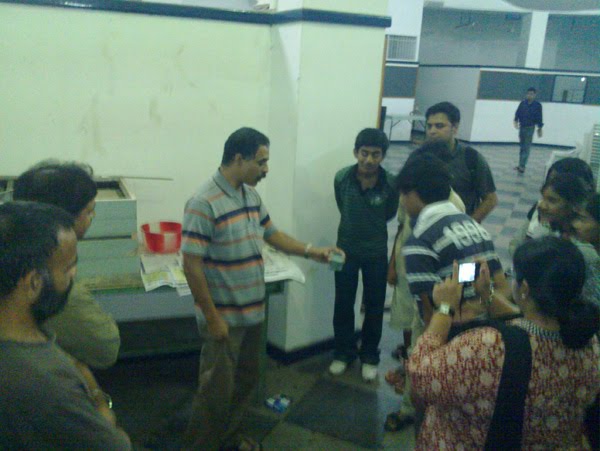
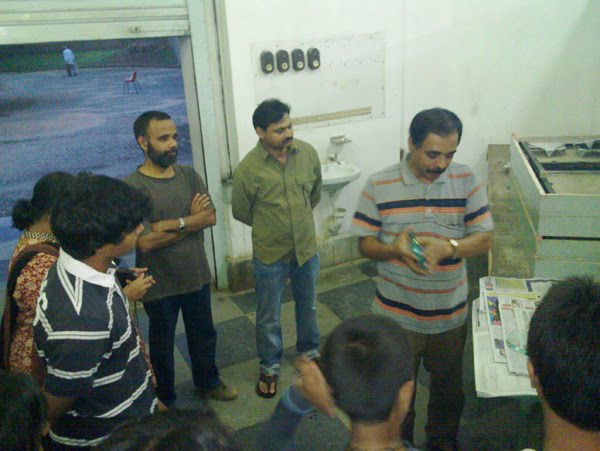
Young and enthusiastic students from Namma Shale started working on a 6 inch mirror from yesterday at ABAA. In coming weeks they will grind, polish and build their own telescope. Here are couple of photos of the start of the mirror making process.

You can also view photos of the ongoing Telescope making workshop at ABAA Facebook
Astronomy Bangalore
ABAA Bangalore
Telescope Bangalore
Telescope Making Bangalore


20 August 2010

Venus at Greatest Elongation today

This evening the planet Venus, the bright evening star, reaches Greatest Elongation. That means the angular separation between the Sun and the planet Venus will be at maximum of 46 degrees, as observed from Earth. After this day the angular separation between the Sun and Venus starts decreasing

If observed through telescope, we can notice that Venus one half lit by reflected light from the Sun and the other half in dark. As the days progress, planet Venus will move from Half phase to Crescent phase, making the planet little more brighter.

Seen through the telescope the planet Venus will slowly increase in size, angular diameter, as the days pass. Now its around 24 seconds of arc and the planet will slowly increase to a diameter close to a minute of arc before reaching inferior conjunction in late October.

Venus is well placed for observations in the western evening sky through out this month.

This evening the red planet Mars will be 1° 57' NE of bright Venus.

Hope the skies will be clear...

04 August 2010

Planets for the Month


Mercury:

Planet Mercury will reach greatest elongation of 27 degrees on 7th of August. After reaching greatest elongation, the angular separation between the planet Mercury and the Sun starts decreasing.

Mercury can be seen low in the western horizon as a bright 0.4 magnitude star, just after sunset.


If observed daily, it can be noticed that, just after the sunset the angle between the horizon and the planet Mercury will start decreasing as days go by.


Planet Mercury will remain in the constellation of Leo all this month, and will be lost in the glare of the Sun towards the last week of August.


Mercury setting times:


Date

Set Time


7th Aug

8:16pm IST

14th Aug

8:00pm IST

21st Aug

7:36pm IST

28th Aug

6:58pm IST


Venus:


Planet Venus is the brightest “star” in the evening western sky now, shining close to -4.5 magnitude. Planet Venus is well placed for observation all this month. Venus will reach greatest elongation on August 20th with an angular separation of 46 degrees from the Sun.


On 8th August, Venus and Saturn can be seen close to each other with an angular separation of just 2.6 degrees. Planet Saturn will be north of Venus.


The crescent Moon will be 4 degrees south of Venus on August 13th. Moon, Venus and Saturn will almost be in a straight line, with red planet Mars placed east of Venus on the evening.


On 20th August, Venus and the red planet Mars will be close each other with a separation of 2 degrees.


Venus setting times:

Date

Set Time

7th Aug

9:18pm IST

14th Aug

9:10pm IST

21st Aug

9:04pm IST

28th Aug

8:57pm IST


Mars:

The red planet Mars will be in the constellation of Virgo all this month. Mars can be spotted easily by taking Venus as reference. Mars will be shining at 1.5 magnitude SE of Venus in the beginning of the month. Middle of month Mars will be in east of Venus and towards the end of the month, Mars will be north of Venus.


Date

Set Time

7th Aug

9:40pm IST

14th Aug

9:25pm IST

21st Aug

9:12pm IST

28th Aug

9:00pm IST


Jupiter:


Jupiter is well placed for observations, in the constellation of Pisces rises around 9:15 in the beginning of the month. The Giant planet is easy to find, shining at -2.5 is the brightest star in the eastern sky at around 9:30pm.


Date

Rise Time

7th Aug

9:20pm IST

14th Aug

8:50pm IST

21st Aug

8:28pm IST

28th Aug

8:00pm IST


Saturn:


Saturn spends the month in the constellation of Virgo this month. In the evening western sky locate bright Venus, just 4 degrees east of Venus, the planet Saturn can be found easily. Towards middle of the month, Saturn can be found north of bright Venus. Saturn can be found NW of Venus and Mars towards the end of August.


Date

Set Time

7th Aug

9:30pm IST

14th Aug

9:04pm IST

21st Aug

8:40pm IST

28th Aug

8:15pm IST


Uranus:


Uranus can be found 3 degrees west of Jupiter. A good pair of binoculars will be needed to see the planet Uranus. A good pair of 7X50 or 10X50 binoculars will show Jupiter and Uranus in the same field. Uranus is 5.8magnitude.


Date

Rise Time

7th Aug

9:15pm IST

14th Aug

8:48pm IST

21st Aug

8:19pm IST

28th Aug

7:51pm IST


Neptune:


Neptune will be in the constellation of Capricornus in the month of August. Planet Neptune can be found at 4 degrees NE of delta Capricorni. Neptune is at magnitude of 7.8. On 20th of August, Neptune will be at opposition.


Date

Rise Time

7th Aug

7:25pm IST

14th Aug

6:57pm IST

21st Aug

6:30pm IST

28th Aug

6:02pm IST


Pluto:


Pluto is in the rich star field of constellation Sagittarius at 14th Magnitude.


Moon Phases for the month:

New moon: 10 Aug 2010

First quarter: 16 Aug 2010

Full moon: 24 Aug 2010

Last quarter: 1 Sep 2010


Sun:


Sun will be in the constellation of Cancer during the first week of August and moves to Leo and will stay in the constellation of Leo all this month.


Meteor Shower:


This month its time for Perseids meteor shower. The peak activity will on the nights of 12th and/or 13th night with 50 to 80 meteors per hour. The shower is called Perseids as the meteors originate from the constellation of Perseus and the constellation rises around 12 in the night. As we are in the middle of the monsoon season, its difficult to get clear skies in this month, hope for the best.


Comet Perihelion (Closest to Sun)

Comet Encke will reach perihelion on 6th of August.

20 July 2010

A visit to Sriharikota

12th Jul, 2010: India's space program received yet another boost, after the successful placing of remote sensing satellite Cartosat-2B and 4 other satellites by the Polar Satellite Launch Vehicle (PSLV) at 9:22am on last Monday.
The PSLV-C15 launch, which came after a 51-hour countdown at the Satish Dhawan Space Centre, Sriharikota was described as 'perfect'. The launch vehicle placed the satellites, one of them a satellite built by 7 engineering students from Andhra Pradesh and Karnataka, into orbit.

A young member of ABAA Amogh had the privilege to visit SDSC and witness the launch. Here is his personal account.

My visit to Satish Dhawan Space Center(SDSC), SHAR
12th July, 5 am
Srikalahasti

I woke up with a start, dad was telling me to wake up. Today, was a big day for me. I was going to SDSC to see the launch of PSLV-C15.
My mom knew a scientist in ISRO who worked in the liquid propulsion systems department. He told my mom that there was a rocket launch on 12th July, so my mom asked him to give us permission to witness it as I liked astronomy and astrophysics a lot. So four of us were going in our vehicle to witness the launching. We stayed in Srikalahasti which is around 64 kilometres from SDSC. It would take us 1 hour to reach Satish Dawan Space Center. So we started at around 5:50 am from the hotel and reached SDSC by around 7:15 am.

There were lots of foreigners mainly Algerians, French and Canadians.This was because apart from Cartosat-2B and Studsat from India there were 3 other satellites on board. Alsat-2A form Algeria but built by the French, two Canadian nano satellites NLS 6.1 and 6.2 were going to be launched along with the Indian satellites.

6km from the launching site is an auditorium named M.R Kurup Auditorium. Visitors have to see the launch from there. It was a really big auditorium fully air conditioned with two big T.V's. But this was not the real excitement I wanted to see it in real. By around 10 minutes before the launch almost all of them who were inside the auditorium went up to the terrace to witness it in real. Then was the count doun 5, 4, 3, 2, 1 and at 9:22 am we could hear the loud noise, see a small pencil like thing with a long tail of fire after around 10 to 15 seconds. When the rocket was out of sight we came back inside and saw the tracking of the rocket. It had a small deviation in its path but that was okay.They tracked for around 20 minutes and when all satellites were into orbit, mission succesful!
-Amogh

14 July 2010

A Sun Halo Over Bangalore

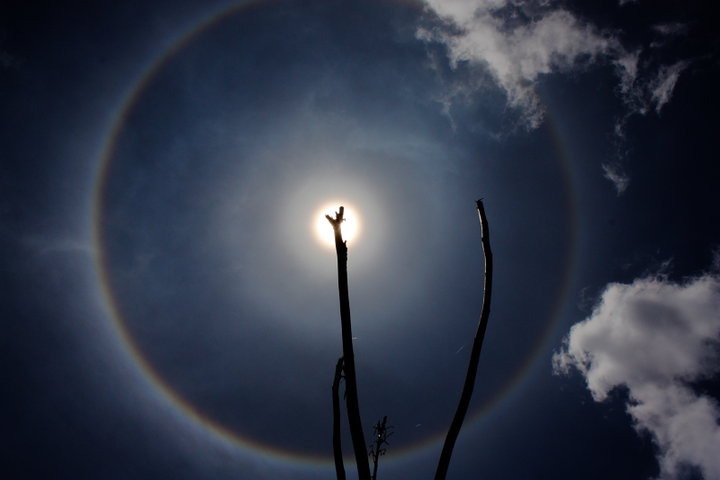
Last Sunday the 11th of July many in Bangalore witnessed a big halo around the sun. Around noon when the Sun was almost at the zenith, there was a rainbow like ring around the sun.


This fairly common sight occurs when high thin Cirrus clouds cover much of the sky. Typically found at heights greater than 20,000 feet (6,000 meters), cirrus clouds are composed of ice crystals that originate from the freezing of supercooled water droplets. Each ice crystal acts like a tiny lens.
Most of these crystals have a similar elongated hexagonal shape and light entering one crystal face and exiting through the opposing face refracts 22 degrees, which corresponds to the radius of the Sun halo.
Similar halo can be seen occasionally round the moon too...

If you saw the halo, leave a comment and tell us about your experience.

14 June 2010

Milky Way Pictures

Here are a couple of pictures of the Milky Way taken under the incredibly clear skies in the Himalayas. The picture of the northern milky way is a mosaic of three exposures and that of the southern milky way is a mosaic of two exposures. All exposures are of 30 sec duration at ISO1600 with a Sigma 17-70 lens set to 17mm at f/2.8.

Milky Way - North

Milky Way - South

02 June 2010

Astro News: Saturn, Mars and Venus line up in June sky

As darkness falls at the beginning of June, three planets will form a long line in the western sky. Saturn will be at the upper left, Mars in the middle and Venus at the lower right.

Sky map for June 6

Venus will form a straight line with the bright stars Pollux and Castor of the constellation Gemini the Twins on June 11 fairly low in the west-northwest. On June 19 and 20, the brilliant white planet will pass just north of the Beehive star cluster. Binoculars will show the stars twinkling while the planet gleams steadily.

Venus on June 19th at 7pm

To Venus's upper left (south) will be red-orange Mars, making a colorful contrast with nearby blue-white Regulus, the brightest star of the constellation Leo the Lion. The colors will appear most vivid through binoculars. Mars and Regulus will be closest on June 6, but they will remain near each other for the first half of the month.

Saturn will materialize high in the southwest at dusk, setting around 1:30 a.m. local time at the start of the month and by midnight at month's end. Saturn's rings will appear to open slightly this month as seen from Earth, after being tilted nearly edgewise in late May. Mars and Venus will close in on Saturn from the lower right (west) as the month advances.

While Saturn is setting in the west, Jupiter will be rising in the east. Jupiter is a favorite target of observers with telescopes, because its rapid rotation causes its features to change position noticeably in as little as 10 minutes. Its four largest moons -- Io, Europa, Ganymede and Callisto -- will be visible in binoculars or any telescope, changing positions from night to night as they patrol east and west of the planet in their orbits. Occasionally one or more of them will disappear as they pass in front of Jupiter or behind it. These moons are bright enough that you could see them without optical aid if it weren't for Jupiter's brilliance. The planet will climb higher in the southeast during June, and views of it will improve quickly.

Mercury will be close to the eastern horizon a half hour before sunrise in early June, difficult to find in the bright sky of dawn.

Provided by IU