Showing posts with label Astronomy. Show all posts

08 June 2026

Venus–Jupiter Conjunction 2026: Understanding Right Ascension and Ecliptic Longitude Conjunctions


The Venus–Jupiter conjunction on 9 June 2026 will bring the brightest planet, Venus, and the largest planet in the Solar System, Jupiter, together in the evening twilight sky. Shortly after sunset, a glance toward the western horizon will reveal these two brilliant worlds shining side by side like diamonds. While most observers will simply enjoy the spectacle, astronomers define this conjunction in two different ways: a conjunction in Right Ascension and a conjunction in Ecliptic Longitude.

A simple example of a conjunction is the New Moon, which occurs every month and is nothing more than a conjunction of the Sun and Moon.

In astronomy, conjunctions are defined in two ways: Conjunction in Right Ascension and Conjunction in Ecliptic Longitude.

Conjunction in Right Ascension

First, let us look at a conjunction in Right Ascension (RA). For this type of conjunction, the celestial objects must have the same Right Ascension, meaning they are equally distant from the First Point of Aries when measured along the celestial equator.

For the Venus–Jupiter conjunction on 9 June, both planets have the same Right Ascension at 6:00 PM IST:

Venus: RA 07h 51m
Jupiter: RA 07h 51m

As shown in the chart, the planets align parallel to the Right Ascension lines. Another way of stating this is that they are aligned perpendicular to a declination line. This configuration is known as a conjunction in Right Ascension.


Conjunction in Ecliptic Longitude

Next, let us look at a conjunction in Ecliptic Longitude.

Ecliptic Longitude is the angle measured eastward along the ecliptic from the First Point of Aries. At first glance, this sounds similar to Right Ascension because both measurements begin at the First Point of Aries and increase eastward. However, the key difference lies in the reference plane used.

Right Ascension is measured along the celestial equator and is expressed in hours, minutes, and seconds, where 15 degrees equals 1 hour.

Ecliptic Longitude, on the other hand, is measured in degrees along the ecliptic, which is the apparent path of the Sun across the sky.

Since the ecliptic is tilted by approximately 23.44° with respect to the celestial equator, the two coordinate systems are not identical. As a result, a conjunction in Right Ascension and a conjunction in Ecliptic Longitude generally occur at different times.

In the chart below, the grid lines represent the Right Ascension and declination coordinate system, while the yellow line represents the ecliptic. Compare this with the ecliptic longitude chart, where the division lines are drawn perpendicular to the ecliptic.

Right Ascension and declination coordinate system

Ecliptic Longitude chart


By examining the orientation of these lines, we can clearly see why the conjunction in Right Ascension and the conjunction in Ecliptic Longitude occur at different times.

Let us examine both conjunctions in more detail using star charts with coordinate lines.

Conjunction in Right Ascension

Date: 9 June 2026
Time: 6:00 PM IST

Venus: RA 07h 51m
Jupiter: RA 07h 51m

The chart shows that, in the Equatorial Coordinate System, the planets are aligned parallel to the Right Ascension lines. This indicates that they are equidistant from the First Point of Aries when measured along the celestial equator.


If we now switch the same chart to the Ecliptic Coordinate System, it becomes visually obvious that the planets are not equidistant from the First Point of Aries when measured along the ecliptic.


Conjunction in Ecliptic Longitude

Date: 10 June 2026
Time: 1:30 AM IST
Venus Ecliptic Longitude      115°46'
Jupiter Ecliptic Longitude   115°46'


The chart below shows that the planets are now aligned parallel to the coordinate division lines that are perpendicular to the ecliptic. This indicates that the planets are equidistant from the First Point of Aries when measured along the ecliptic.


In other words, the planets had to move a little farther after the Right Ascension conjunction before achieving alignment in Ecliptic Longitude.

Conclusion

When you observe the Venus–Jupiter conjunction on the evening of 9 June, I hope you will remember that there is more than one way to define a conjunction. Whether it is a conjunction in Right Ascension or a conjunction in Ecliptic Longitude depends entirely on the coordinate system being used.

Understanding the difference between these two types of conjunctions provides a deeper appreciation of how astronomers measure positions in the sky and why the same celestial event can have slightly different timings depending on the coordinate system chosen.

SKY FOR THE WEEK


The concepts presented in this article were discussed during the Sky for the Week session held on 7 June 2026 at the Association of Bangalore Amateur Astronomers (ABAA). In these weekly Sunday sessions, members and visitors explore upcoming celestial events, learn how to observe them, and discuss the astronomical principles behind what we see in the sky.


From planetary conjunctions and lunar events to eclipses, meteor showers, and seasonal sky highlights, the sessions aim to connect celestial observations with the science that explains them. Understanding not only what happens in the sky, but also why it happens, helps observers develop a deeper appreciation of astronomy.

The Sky for the Week sessions are conducted every Sunday and are open to anyone interested in exploring the wonders of the night sky.


13 July 2022

Comet PANSTARRS closest to Earth on July 14th


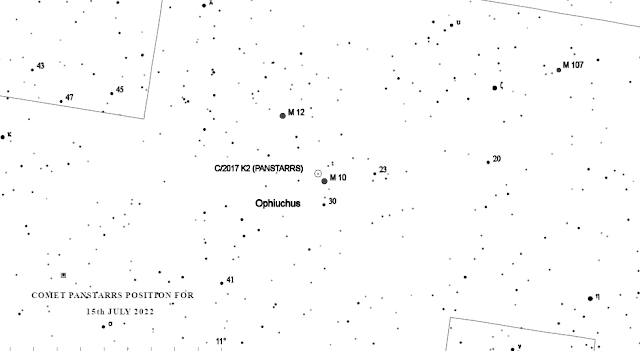
Comet PANSTARRS, C/2017 K2, will be closest to earth on 14th July 2022. The comet at its closest to earth will have a distance of 1.8AU or 269,276,167km in the constellation of Ophiuchus, this distance puts the comet beyond the planet Mars orbit.. The comet is bright enough to be seen in binoculars and small telescopes, the comet has a magnitude of 8. The comet PANSTARRS is well placed for observation, at the time of Sunset the comet will have an altitude of 45 degrees from the horizon, this gives plenty of time to observe, the comet will set at 3:45am.


Comet PANSTARRS, C/2017 K2, is easy to spot in the sky thanks to its closeness to the M10 globular cluster. The comet will be well within the field of view of binoculars, 20X80, until 18th July. Globular cluster M10 is a bright object at 6.6 magnitude, once M10 is the field it won’t be difficult to spot the fuzzy comet . The size of the comet will be roughly the size of M10. 


On 15th July the Comet PANSTARRS, C/2017 K2, will be closest to M10 with a separation of 25 arc minutes. At this small separation the comet and the globular cluster will be in the same field in the telescope, making it a wonderful sight and also to compare the brightness and size of the comet. Hope you all get a chance to view and photograph the comet. 


18 June 2020

Partial Solar Eclipse from Bangalore 21 June 2020

After the partial solar eclipse on December 26, 2019 which was visible from Bangalore, now after six months we have one more partial solar eclipse visible from Bangalore. 

On June 21st Sunday we are going to witness the partial solar eclipse in the morning sky. The eclipse will start at 10:12:56 and at this time Sun will be 58 degrees above the eastern horizon. With proper solar filter or using different safe observing methods its a good idea to start observing couple of minutes before the given time. The start of eclipse is when you see moon disc starts coming inside Sun's disc, this is called first contact, when Sun and Moon discs touch each other. As we observe the dark disc of moon will start covering more and more of the Sun's disc and after reaching a certain point the disc of moon starts to move away. This is called Maximum eclipse, the point or time when Moon covers the maximum surface of Sun's disc. This will occur at 11:47:38 and at this time Sun would have moved higher in the sky at close to 77 degrees from eastern horizon. As we continue observing or photographing we will see that the dark disc of moon getting smaller and it will come out of Sun's surface completely at 13:31:44 marking the end of eclipse, the time of moon disc coming of Sun is called last contact. At this time Sun will be in the western part of the sky at close to 70degrees from the western horizon. 

Solar Eclipse Bangalore 21 June 2020


As we all know June 21st is Solstice, on this day Sun's reaches the northern most point from equator at 23.5degrees. From June until December Sun will move in southern direction. Sun on June 21st will be on the border of Taurus and Gemini constellations. The borders of constellations are set by International Astronomical Union (IAU). The shapes and borders differ in different regions and cultures, Astronomers use the shapes and borders set by IAU.

This eclipse is an annular eclipse and parts of north India will witness the ring of fire, that is Sun will appears like a ring with moon obstructing the disc of Sun leaving only edges around the Sun glowing. The reason for this ring is because of different apparent sizes of Sun and moon. These two objects subtends an angle of half of degree in the sky, if one of them is smaller or bigger we get annular eclipse. If moon has an angular diameter smaller then the Sun we have annular eclipse as moon cannot cover the entire disc of Sun. Here are the angular sizes of Sun and Moon on June 21st Sun will have a of Diameter: 31'28.4" and Moon will have a Diameter: 31'16.0". As we can see Moon is smaller and this is the reason for annular eclipse. The difference in sizes happens due to elliptic orbit of earth around the Sun and elliptic orbit of moon around the earth. 

Eclipses are rare and we have to travel long distances to be in the center path, we have to go to north India around Kurukshetra to see the ring of fire, annular eclipse on June 21st. Last year on December 26th we had to go to Kerala and Tamil Nadu to witness the annular eclipse. Since we are unable to travel in these lock down situations, we will have to wait until May 21st 2031 to enjoy the solar eclipse in India. The path of annular in 2031 will be in south India.

If some one decides not to leave Bangalore for eclipse but wants central path of eclipse to come to Bangalore, they will have to wait for the year 2085. Yes, on June 22nd 2085 people in Bangalore can see the ring of fire, the annular eclipse. Mark your calendars, it just 65 years away.

For now we have to be content with partial eclipse on Sunday and hope for clear skies. Happy observing every one, observe safely with proper filters or pin hole camera projection on the wall. NEVER LOOK AT SUN DIRECTLY.


26 September 2017

Remembering names of Moon Phases


We are seeing moon getting brighter in the evening sky every day from the last new moon on 20th. With each passing day more area of the moon is illuminating and we can see lot of features on the moon. Many people have confusion when it comes to naming the phases of the moon, so here is a something useful to remember the names.


First, we start with couple of days after the new moon, the phase we are seeing is crescent phase a thin sunlit part of the moon and since the sunlit part is getting bigger with passing days we call it waxing crescent. This is from old English meaning something that grows, here the brighter side is growing.

Waxing crescent moon. Sunlit part towards west.

Next is First quarter, this phase happens when the Sun, earth and the moon align in such a way that Sun and moon are at right angles as seen from earth. We can seen this in the evening sky, on the evening of the first quarter at sunset, we can measure the angle between Sun at the horizon and the moon and the angle will be 90 degrees or close to 90 degrees depending on actual time of alignment.

First Quarter moon. Sunlit part towards west.

Between First quarter and Full Moon, when more then half of the moon is lit up by sunlight we call it gibbous phase and since the brightness is increasing its waxing gibbous phase.

Waxing gibbous moon. Sunlit part towards west. 

After the first quarter comes the Full moon phase, which we are all familiar with, in astronomy we call moon is in opposition. The moon and the sun are on the opposite sides of the earth, if they are exactly aligned then we have a lunar eclipse.

Full moon


From new moon phase the moon was in the sky before the sunset and would set late as the days passed until Full moon when it rises at sunset. After this the moon rises late after sunset and the brightness starts decreasing.

Waning gibbous moon. Sunlit part towards east.


Since its decreasing and more then half is lit, but not fully lit, we call it waning gibbous phase. After that moon reaches last quarter again attaining right angle with the sun. This means the moon will by high in the sky at sunrise. The next phase in waning crescent where we see thin lit surface of the moon and finally reaching new moon phase.

From new moon to full moon, we see the lit part is towards west and from full moon to new moon, we see the lit part towards east, the lit part will be towards the sun.

Now I think there is no problem in telling the phases below,

Last Quarter moon. Sunlit part towards east.
Waning crescent moon.Sunlit part towards east.


15 February 2017

Watch Brightest Venus on Friday


After Sunset in the western twilight sky we see a bright star outshining all the starts in the evening sky, this is the planet Venus. The visual apparent magnitude of the planet Venus is now -4.6 and the apparent magnitude of brightest star in the night sky, Sirius, in the constellation of Cains Major is -1.46 this makes Venus 18 times brighter than Sirius. 
Brocken Inaglory, Venus-pacific-levelled, CC BY-SA 3.0
On February 17th Venus will reach its brightest crescent phase and this is called Greatest Illuminated Extent, the amount of illuminated crescent and the angular diameter of the planet Venus. Venus will have an angular diameter of 39 arc seconds and fraction of illumination is .273 of the angular diameter. After this day the illuminated side will start decreasing and we will see the crescent getting thinner. By second week of March the illuminated fraction will be only .085 of the diameter of the planet and magnitude would have come down to -4.4 still brightest in the evening sky. 

View Through the Telescope on 17th of Feb


View Through the Telescope on 10th March


The planet Venus will slowly fade into glare of the Sun and will reach inferior conjunction on March 25th. In April we will see Venus in early morning sky before sunrise and again the Greatest Illuminated Extent will happen on April 30th. Time to take out the telescopes and observe Venus in coming days, if you don't have one you are always welcome at ABAA on Sundays evening and see the Venus through our telescope. Venus sets at 9pm now and in middle of March the planet will set at 7:30pm.


30 December 2015

Looking and Observing


When crowd gather around binoculars and see the Moon for the first time through binoculars, their reaction is that, the moon looks the same even without the aid of binoculars. Ask them to spend some time at the binoculars and slowly they will start enjoying the view, as they start to Observe the details on the moon surface. This is true even with low power telescopes.

This is the difference between looking and observing which I am sure most people would have experienced in their initial stages.

Even when it comes to other celestial wonders, the situation is the same spend very little time at eyepiece and there is little to be seen but spend more time at eyepiece and details we can see are amazing.

Let me give an example of difference between looking and observing. Take a look at the image and at first sight it appears the same, little closer look will show couple of differences but as on spending time and studying the details will show lots of differences in the images.


When at eyepiece spend as much time as possible studying the object, for example if it is the moon study the shape of the craters, the shadow patterns at different phases of moon and so on. If it is a galaxy, study the dust lane, the arms and structure.  Cluster offers their own challenges like resolving and types of stars in the cluster. We cannot pick up such fine details if we are in a hurry, more time at eyepiece more details we will pick up.  Change the magnification, use different filters, study the object in different telescopes, you will be amazed on how on objects appears in different magnification, filters and apertures.


I always advice people not to fill the pages with number of objects they saw in a single night, but to fill the pages with the details on what they observed. There is no rush, take time in observing and keep challenging yourselves on how much more details you can see and minimum aperture needed to see the details. 

Why just Look when you can Observe!

08 June 2015

Venus and Jupiter Conjunction on July 1st


In the western evening sky we have 2 bright objects, one closer to horizon is Planet Venus and next is Planet Jupiter. As we are observing from past couple of weeks, we have noticed something curious, Venus and Jupiter are getting closer to each other.


These two planets appear getting close to each other, this is as seen from earth, the fact is Venus, the brightest planet in the sky and Jupiter the largest planet in the solar system are 0.5AU and 6AU respectively from earth (1 Astronomical Unit =14,95,97,871 km).  

We will continue to track these planets in coming days and we will notice that the separation will get even smaller. The separation of these planets as seen from earth is measured in angles.

In the middle of June the separation between Venus and Jupiter will be 14 degrees and on 20th the separation will be reduced to 6 degrees.


Minimum separation between Venus and Jupiter will happen on July 1st with a separation of 24 minutes, close enough to fit both planets in field of view of telescope. Venus and Jupiter will set at 9:30pm on 1st July.


02 August 2014

Daytime Occultation of Moon and Saturn August 4th


Daytime occultation, second of this year will be of Moon Occulting Saturn. Earlier this year in February we saw Moon occulting Venus in the daytime, both Venus and Moon were easily visible because of their brightness.  
 

On August 4th, we will see Moon occulting Saturn in the daytime, but we will need telescope to see Saturn as the surrounding sky will be very bright.
Stellarium generated image.
 
The occultation will begin 2pm IST as seen from Bangalore, its always a good practice to start observing as early as possible. Saturn will disappear from dark side of the moon and emerge from the sunlit side at 2:40pm.
Do not try to locate Saturn with the telescope if you are new to finding planets during daytime. As bright Sun will be very close, accidental viewing of Sun through the telescope will be disastrous to the eye.
Here are the times and positions of the Planet for those who have setting circles
August 4th Occultation.
Time
Right Ascension
Declination
Altitude
Azimuth
13:45
15:00:00
-14:44:27
14:36
109:18
14:00 Start
15:00:00
-14:44:27
18:00
110:27
14:40 End
15:00:00
-14:44:27
27:15
114:20
 
Deg:Mins:Secs
Deg:Mins:Secs
Deg:Mins:Secs
Deg:Mins:Secs

Its a matter of luck to have clear skies in this monsoon season, but its always better to be prepared and hope for the best. 
Clear Skies 

01 July 2014

Occultation Demonstration setup at ABAA


At ABAA, we try to make concepts of astronomy simple so that everyone can visualise and understand. This setup I made at ABAA using materials that we can find easily and we can build this at very low cost and fast. The setup is to show occultation concept, consists of a motor, a light source that acts as a star and a dick attached to motor to show an object coming in front of the star, Occulting the star.

Moon Occulting Venus 


Occultation is an astronomical event when one astronomical object comes between observer and a distant object. For example, moon in its journey in the night sky comes in between background stars and us, this we call moon is occulting stars.


I made the video with external lights on and off, to show the setup working. With lights on, we can see the disk coming in front of the light source and Occulting the Star and with lights turned off we can simulate night sky and we can measure star light disappearing and re appearing. Using different sizes of disc, we can show that occultation helps in determining the size and shape of an object using the time of appearance and disappearance to the star.  

30 March 2012

ABAA News:Talk on Stellar Parallax & Distance measurement to Stars

Last Sunday at ABAA there was an interesting talk and discussion on Stellar Parallax. I had asked Jayanth if he could send a small write up of the talk that he gave on the "Stellar Parallax & Distance measurement to Stars" so that it can be made available to all our blog readers. In his busy schedule Jayanth did manage to find some time to write a summery of the talk on Sunday. Here is the Article and Photos of the session.


What is Parallax?

To visualize this, See any object close to you say a few centimeters away, and look at it alternatively with your left eye closed and then with the right eye. You will notice that the position of the object seems to be different with reference to a far off background objects. You will notice that the object shifts from one position to other alternatively when you see the same once with your left and righ eye. The reason for this is not the object shifting but shifting the place you watch the object from. Your right eye and left eye.

The angles at which your eyes have to look obviously depend on the distance of the object and the distance between your two eyes. nose. The angle gets smaller with larger object to eye distance and smaller eye to eye distance. Therefore the difference in angles can be used to measure the distance to the object if you know the distance between your two eyes!. This difference in angles is called theparallax. The distance between your eyes is called the baseline; the bigger the baseline is, the bigger the parallax is, for the same distance of the observed object to the baseline.


The stars are very far away from us and their parallax is so small that the short baseline from one eye to another is too small to detect or even measure. In order to measure this small parallex of stars, we need a larger base line. A large base line is available which is the diameter of earths orbit = 2 Astronomical Units (AU) = 300 million KM.arth. Simply look where (at which angle) a star is in summer in the sky, and then look again where (at which angle) the same star is in winter in the sky, determine the difference in angles, and you have the parallax for this star. Now you can compute the distance to the star. The following picture should illustrate this:

Description: Description: Illustration of a parallax. The distance to the star measured in parsecs is two divided by difference between two measurements of the angle to the star measured six months apart.
Here in this calculations Parsec (parallax second) is the distance of a star that would have a parallax of two arc seconds, or, equivalently, the distance from our sun at which the angle between earth and sun (1 AU) would be one arc second. Using this unit t is useful because for large distances involved, distance is inversely proportional to the parallax. Hence a star with a parallax of x arcseconds is 2/x parsec away. This way we can calculate, one parsec is approximately 206,000 AU, or 3.09 × 10¹³kilometers, or 3.26 light years.

The closest star is 4.2 light years away which means parallax of the closest star  will be less than one parsec. In order to measure such small angles, instruments with great precision are needed. Parallax to a star 61 Cygni was measured by astronomer and mathematician Wilhelm Nessel in the year 1838 from Konigsberg observatory and the value was 0.314 arc seconds. The modern value is 0.292 arc Seconds (total angles) which computes the distance to this star close to 10 light years.


Due to the precision of measurements required by this method and the atmospheric distortions limiting the accuracies, 1989 the satellite Hipparcos was launched which has the capability of measuring parallax down to 1 milli arc second. This means Satellite Hipparcos was capable of using Parallax method to estimate distance to near by stars up to 1600 light years. Another satellite named GAIA  launched in 2010 is  able to measure even more distant stars, up to 32000 light years.

By using radio waves instead of visible light, one can measure even smaller parallaxes, even down on earth, without the need for satellites. Using Very Long Baseline Interferometry (Two radio telescopes with a large distance between them which is usually on different sides of the earth) improves the measurement of angles greatly. The precision is in the order of 100 micro arc second.


04 August 2010

Planets for the Month


Mercury:

Planet Mercury will reach greatest elongation of 27 degrees on 7th of August. After reaching greatest elongation, the angular separation between the planet Mercury and the Sun starts decreasing.

Mercury can be seen low in the western horizon as a bright 0.4 magnitude star, just after sunset.


If observed daily, it can be noticed that, just after the sunset the angle between the horizon and the planet Mercury will start decreasing as days go by.


Planet Mercury will remain in the constellation of Leo all this month, and will be lost in the glare of the Sun towards the last week of August.


Mercury setting times:


Date

Set Time


7th Aug

8:16pm IST

14th Aug

8:00pm IST

21st Aug

7:36pm IST

28th Aug

6:58pm IST


Venus:


Planet Venus is the brightest “star” in the evening western sky now, shining close to -4.5 magnitude. Planet Venus is well placed for observation all this month. Venus will reach greatest elongation on August 20th with an angular separation of 46 degrees from the Sun.


On 8th August, Venus and Saturn can be seen close to each other with an angular separation of just 2.6 degrees. Planet Saturn will be north of Venus.


The crescent Moon will be 4 degrees south of Venus on August 13th. Moon, Venus and Saturn will almost be in a straight line, with red planet Mars placed east of Venus on the evening.


On 20th August, Venus and the red planet Mars will be close each other with a separation of 2 degrees.


Venus setting times:

Date

Set Time

7th Aug

9:18pm IST

14th Aug

9:10pm IST

21st Aug

9:04pm IST

28th Aug

8:57pm IST


Mars:

The red planet Mars will be in the constellation of Virgo all this month. Mars can be spotted easily by taking Venus as reference. Mars will be shining at 1.5 magnitude SE of Venus in the beginning of the month. Middle of month Mars will be in east of Venus and towards the end of the month, Mars will be north of Venus.


Date

Set Time

7th Aug

9:40pm IST

14th Aug

9:25pm IST

21st Aug

9:12pm IST

28th Aug

9:00pm IST


Jupiter:


Jupiter is well placed for observations, in the constellation of Pisces rises around 9:15 in the beginning of the month. The Giant planet is easy to find, shining at -2.5 is the brightest star in the eastern sky at around 9:30pm.


Date

Rise Time

7th Aug

9:20pm IST

14th Aug

8:50pm IST

21st Aug

8:28pm IST

28th Aug

8:00pm IST


Saturn:


Saturn spends the month in the constellation of Virgo this month. In the evening western sky locate bright Venus, just 4 degrees east of Venus, the planet Saturn can be found easily. Towards middle of the month, Saturn can be found north of bright Venus. Saturn can be found NW of Venus and Mars towards the end of August.


Date

Set Time

7th Aug

9:30pm IST

14th Aug

9:04pm IST

21st Aug

8:40pm IST

28th Aug

8:15pm IST


Uranus:


Uranus can be found 3 degrees west of Jupiter. A good pair of binoculars will be needed to see the planet Uranus. A good pair of 7X50 or 10X50 binoculars will show Jupiter and Uranus in the same field. Uranus is 5.8magnitude.


Date

Rise Time

7th Aug

9:15pm IST

14th Aug

8:48pm IST

21st Aug

8:19pm IST

28th Aug

7:51pm IST


Neptune:


Neptune will be in the constellation of Capricornus in the month of August. Planet Neptune can be found at 4 degrees NE of delta Capricorni. Neptune is at magnitude of 7.8. On 20th of August, Neptune will be at opposition.


Date

Rise Time

7th Aug

7:25pm IST

14th Aug

6:57pm IST

21st Aug

6:30pm IST

28th Aug

6:02pm IST


Pluto:


Pluto is in the rich star field of constellation Sagittarius at 14th Magnitude.


Moon Phases for the month:

New moon: 10 Aug 2010

First quarter: 16 Aug 2010

Full moon: 24 Aug 2010

Last quarter: 1 Sep 2010


Sun:


Sun will be in the constellation of Cancer during the first week of August and moves to Leo and will stay in the constellation of Leo all this month.


Meteor Shower:


This month its time for Perseids meteor shower. The peak activity will on the nights of 12th and/or 13th night with 50 to 80 meteors per hour. The shower is called Perseids as the meteors originate from the constellation of Perseus and the constellation rises around 12 in the night. As we are in the middle of the monsoon season, its difficult to get clear skies in this month, hope for the best.


Comet Perihelion (Closest to Sun)

Comet Encke will reach perihelion on 6th of August.