06 September 2012

ABAA NEWS: Discussions on Magnitude system.


Every Sunday evenings there are discussions on astronomy topics at ABAA, Here is a summary of discussion that took place in the middle of August. The discussion was on Magnitude system.

Apparent magnitude

Members had discussion on Magnitude system in astronomy. Starting with Apparent magnitude, the brightness of stars as seen from earth. Hipparchus, Greek astronomer grouped the brightest stars as first magnitude, little fainter stars became second magnitude, and the faintest star eye could see as sixth magnitude. The difference in brightness from one magnitude is 2.512 times, that makes 1st magnitude star is 100time brighter than 6th magnitude star.

Sirius (brightest star)
-1.5
Venus (at brightest)
-4.4
Full Moon
-12.6
The Sun
-26.8
Faintest naked eye stars
6
Uranus
5.7
Neptune
8
Pluto
14


In magnitude system, negative is brighter and positive is fainter. As negative number increases the brightness increases, for example our sun has apparent magnitude of -26.8 making it brightest and Uranus has apparent magnitude of +5.7 which is fainter. 

Absolute Magnitude:

Apperant magnitude are brightness of stars as seen from earth irrespective of distances. The brightness of stars, the magnitude they appear when placed at a constant distance is called Absolute magnitude. The magnitude that stars will appear when placed at a distance of 32.6 light years which is 10 parsec( 1 parsec = 3.26ly).


Our Sun placed at this distance will have magnitude of 4.8 and Sirius, brightest star in the night sky with apparent magnitude of -1.46 will have absolute magnitude of 1.4. Members discussed in detail on these topics like calculating apparent magnitude of Sun.

The colour of sun, the topic was good in the sense that most of us think it should be yellow or red as seen from earth. But in the course of discussion it was concluded that Sun will appear white.


The topics like Luminosity, distance modulus etc were discussed in detail.

ABAA NEWS: Celestial co-ordinate system discussion


As monsoon is covering the skies, ABAA members are spending time in discussing astronomy topics and helping newcomers in understanding basic concepts in astronomy. I am updating couple of such activities at ABAA from past few weeks.

Celestial co-ordinate system discussion:

Members discussed on the celestial sphere and co ordinate systems in astronomy, getting better understanding on different types of co ordinate systems. In Equatorial Coordinate System how the declination circle is defined, the zero declination circle is projection of earth's equator. Members discussed on Right Ascension(RA) on how first point of Aries is defined and where the actual first point lies now due to earth's precession. Here are few photos of the session


Planets for the Month of September


Morning Planets:

Mercury:

Mercury will reach superior conjunction on September 10th and it will towards the end of the month that Mercury will be placed well for observing.


Jupiter:

Jupiter is well placed for observations in the constellation of Taurus. The giant planet rises early at 11:45pm and has a magnitude of -2.4.  

Venus:

Morning star Venus is well placed of observations through out the month. Venus rises at 3am in the constellation of Cancer shining at a magnitude of -4.2. The planet will just 2 degrees from M44 or beehive cluster as popularly known, on September 14th making it a fantastic view in binoculars. Seen through the telescope Venus will appear just more than half phase, moving towards gibbous phase as days go by.


Evening Planets:

Mars:

Mars is in the evening twilight in the constellation of Libra. The red planet is at a magnitude of 1.2 and will set at 9:20pm.

Saturn:

Saturn is also placed low in the Western horizon, in the constellation of Virgo. The planet sets early at 8pm.


Uranus:

Uranus is well placed for observetion through out the month. Uranus rises early at 7pm giving full night for observations. This planet is visible through a pair of binoculars is at a magnitude of 5.7. Uranus will reach opposition on September 29th.

Neptune:

Neptune is also well placed for observations through out the month in the constellation of Aquarius. Neptune has a magnitude of 7.8.


Moon Phases:

Last quarter: 08-Sep-2012
New moon: 16-Sep-2012
First quarter: 22-Sep-2012
Full moon: 30-Sep-2012


Sun:

On September 22nd Sun will reach autumnal equinox, when Sun's declination becomes zero and Right Aessionsion(RA) becomes 12 h. The Sun will reach this co ordinates at 9pm IST on September 22. Although this point is called First point of Libra, the Sun will be in Virgo constellation.


08 June 2012

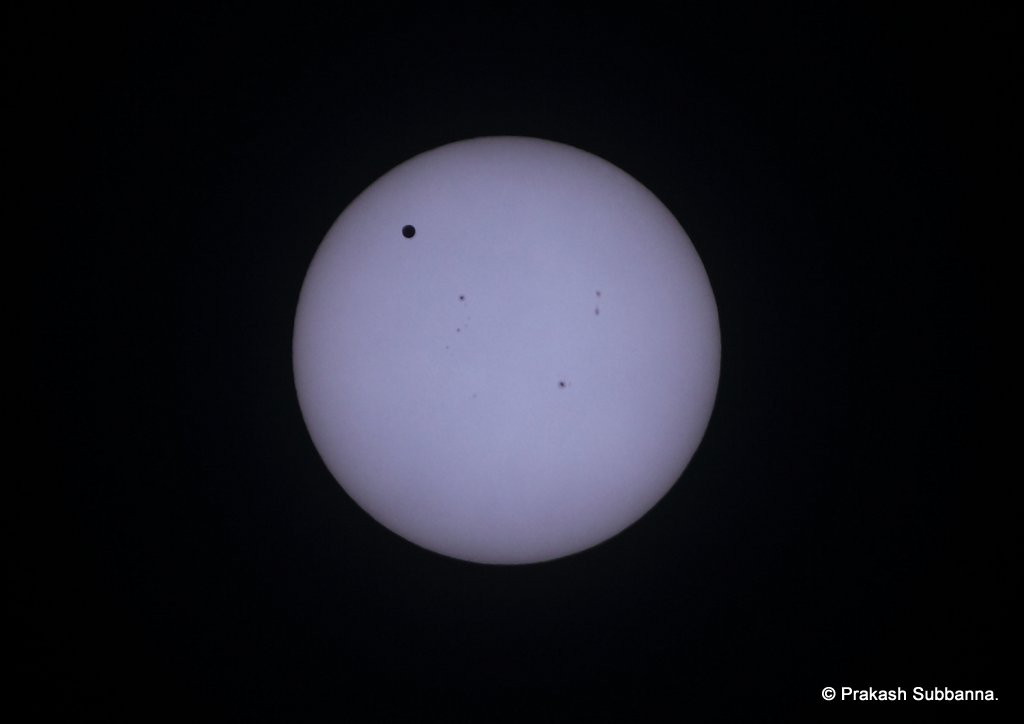
Venus Transit Photos by Prakash Subbanna

Here are photos of Venus Transit taken by Prakash Subbanna Vice President ABAA. He took these photos with his Canon EOS 1D mark IV, Lens CANON 600MM L IS USM, Tripd MANFROTTO PRO,  ARCA SWISS Z1 BALL HEAD, Filter:  BADER. 


04 June 2012

Arrangements for viewing Transit of Venus in Bangalore

JAWAHARLAL NEHRU PLANETARIUM, Bangalore and ABAA have made arrangements for viewing Transit of Venus on 6th June. The telescopes and other viewing aids will be kept for public from 7am to 9:30am at JNP campus. All are welcome to witness the event, remember next venus transit will be in 2117AD.

22 May 2012

Last Venus Transit of the Century


We have waited 8 years for this event on June 6th this year and if we miss it, its just another 105 years wait for this event to re occur. This event is Transit of Venus, and the last time we observed was on June 8th 2004 and its going to take place again on June 6th this year. In 2004 we could see both Ingress, that is Planet entering Sun's disc, and also Egress meaning Planet coming out of Sun's disc. Many had luck observing the full event but a lot of us had to deal with clouds, as monsoon was just starting.

Since March 26th 2012 after the Greatest Elongation of Venus, we are observing the planet slowly shrinking in altitude in the evening sky and also observing the changing phases of Venus through the telescope, Venus changing from Half lit to Crescent phase and also we have been noticing that the  planet is  getting bigger in angular size and with this we can conclude that Venus is coming closer and in a few days time it will be between the Earth and the Sun.

When Venus comes between Earth and the Sun, the planet is said to be in Inferior Conjunction. On June 6th Venus will be in Inferior Conjunction, this day also happens to be when Venus and Earth lie in the same orbital plane making Sun, Venus and Earth lie in an exact line. When this happens, we can see Venus moving across the Sun's disc, This is called Transit of Venus.

Why  Venus transit does not happen on all Inferior Conjunctions? This is because, Venus's orbital plane is inclined at an angle of 3.39 degrees and only when Venus and Earth line up exactly in this  plane, we can see a transit. The alignment of Earth orbit meeting the Venus orbit happens in the month of June and December, during this time when the planet aligns exactly in line we see a transit. Venus Transits reoccur at intervals of 8, 121.5, 8 and 105.5 years, last was in 2004 and now in 2012, we are going to see it again in 2117 and 2125 both in December.

For our region Venus Transit on 6th June starts at 3:40am so we have to wait till sunrise to see the transit. It would be a wonderful sight to watch sunrise with Venus as a black circular dot in the north on Sun's disc.

Sun Rise at 5:52am

Transit starts
03:40:00 AM
Minimum separation
07:00:00 AM
Sun Altitude 14degrees 30minutes
Transit Ends
10:20:00 AM
Sun Altitude 60degrees 18minutes


Make sure you are in an area where you have clear horizon and its not blocked by buildings and trees. Never look at the sun directly, the best way to observe the sun is through the sun filters.

Ways of observing the event :

NEVER LOOK AT THE SUN DIRECTLY, ALWAYS USE PROPER FILTERS.

Viewing with the help of Binocular:

If you have a pair of binoculars you can fix the binocular on to a stand and project the image of the Sun on to a cardboard or wall and safely watch the Transit. Do not point the binoculars at the sun for long duration at a time. Again NEVER LOOK AT THE SUN DIRECTLY THROUGH THE BINOCULAR use binoculars only to project the image.


Observing with help of telescope:

If you have a telescope, you can use the telescope to project the image of the sun on to a wall or a screen. Before doing that it is advisable to make a mask with small opening that is smaller than the mirror size, like the one shown in the photo and attach it in front of the tube to reduce intensity of the sun and also this will help in increasing the contrast of the image.

This is called an off axis mask.


NEVER LOOK THROUGH THE TELESCOPE AT THE SUN, THIS WILL DAMAGE YOUR EYES PERMANENTLY.

After attaching the mask you can use the telescope to project the image and observe it safely. 


Every few minutes move the telescope away from the sun so that the heat of the sun does not damage the optical system.

Buy a proper solar filter to observe the sun, do not use sun glasses to see the sun.

Cassegrain telescopes should not be used to project sun, as the internal heat can damage the optical system. 

You can visit transitofvenus.org website for further information on observing advice.

Hope you all have a wonderful observing session this June 6th. Make sure you spread the word and educate people about the Transit.

All the best and Clear skies.


02 April 2012

ABAA Outreach


ABAA had been to Neev - Indiranagar to introduce kids to astronomy and show them Venus and Moon through the telescope. The talk soon converted into a interactive session with kids asking and sharing their understanding of astronomy. Its amazing how much kids know. After the talk kids enjoyed the view of Venus and Moon through the telescope. 

ABAA conducts outreach programs from time to time in schools and colleges to create awareness and help students understanding Astronomy and Telescopes better.

Here are few photos we want to share with you of the session.


ABAA member Bharath giving the talk.