20 September 2010

First light of ATM workshop telescope

It was a nice evening at ABAA on Sunday 19th, as the first telescope of this year's ATM workshop saw the first light. The 6 inch telescope mirror was ground and polished by ATM workshop participant Amrutha. The skies were pretty decent, as shiva prasad described it, with very little haze. Later the haze also cleared. The First object the telescope observed was Moon, in gibbous stage. Members and ATM participants enjoyed observing moon's surface and few photos were taken, thanks to Anita and her iPhone 3GS.


Next was the giant planet Jupiter. Witnessing the transit of IO on the surface of Jupiter and wonderful sight of emergence of IO was a good experience.


Congratulations to Amrutha for completing the telescope. In coming couple of Sundays all the telescope will see the first light.


Moon taken through Amrutha's telescope with 9mm eyepiece. Camera is Anita's iPhone 3GS.


Another pic of Moon taken through Amrutha's telescope again with 25mm eyepiece. Camera is Anita's iPhone 3GS.


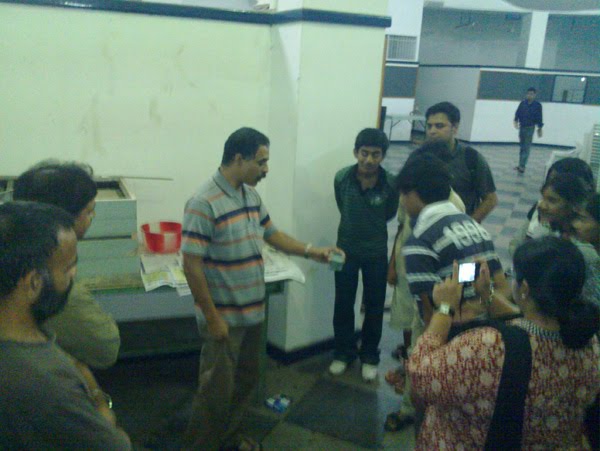
Vinay trying to photograph Moon with his mobile phone. Anita and Shiva waiting to see the result.


17 September 2010

Mercury greatest Western elongation

On Sunday 19th, the planet Mercury will reach Greatest Western elongation. It is called Western elongation because the planet will be west of Sun, although we will be seeing the planet in Eastern horizon. Maximum angular separation of Mercury from the Sun will be 18degrees. As Mercury will be low in the horizon, clear horizon is essential. Mercury will rise at 5am and will reach little comfortable viewing altitude of 12 degrees at 5:50am.

Sun will rise at 6:08am on Sunday.


06 September 2010

Aluminized Mirrors

First set of mirrors from the on going ATM workshop are now aluminized and was brought to ABAA on Sunday evening.
Here are few photos of the Aluminized mirrors.

Jayanth, President of ABAA checking the Aluminized surface.


Mirrors in the Box

All mirrors now waiting to be assembled.


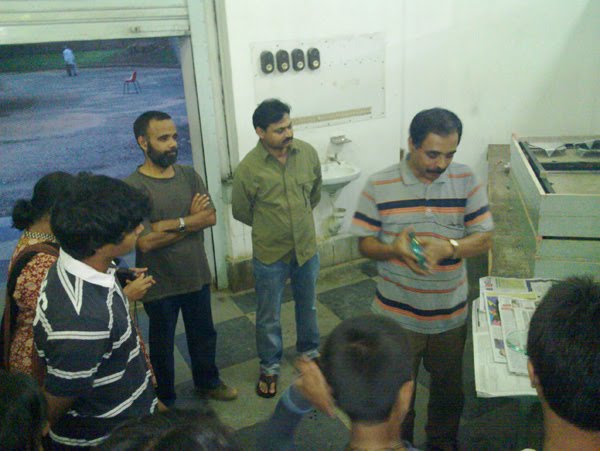
Teachers from Namma shale, Jayanth and Viji(from right to left), Jayanth explaining the process.


03 September 2010

Planets for the Month

Mercury:

Mercury will reach inferior conjunction on September 3rd. It will be lost in the Sun's glare in the first week of September. During second week, Mercury will be too close to eastern horizon at around 8 degrees at 6am. After 15th the planet Mercury will be little easy to spot if there is a clear horizon. Mercury will reach greatest elongation on 19th September, the angular separation from the Sun will be 18degrees. Mercury will be in the constellation of Leo all month.


Date

Rise

1st Sep

06:35:00 AM

8th Sep

05:35:00 AM

15th Sep

05:02:00 AM

22nd Sep

04:59:00 AM

29th Sep

05:15:00 AM


Venus:

Venus will continue to dominate the evening western sky all this month. On 11th September, Venus and crescent Moon will be close to each other at a separation of just 1 degree.


Date

Set

1st Sep

08:53:00 PM

8th Sep

08:43:00 PM

15th Sep

08:31:00 PM

22nd Sep

08:16:00 PM

29th Sep

07:57:00 PM

Venus and Mars

Mars:

The red planet will be in the constellation of Virgo all month. Mars can be spotted in the western sky evening sky 6 degrees north of Venus.


Date

Set

1st Sep

08:50:00 PM

8th Sep

08:38:00 PM

15th Sep

08:26:00 PM

22nd Sep

08:15:00 PM

29th Sep

08:04:00 PM


Jupiter:

Jupiter is well placed for observations as it rises early in the evening. The giant planet will the brightest “star” in the region at -2.5 magnitude.

On 19th September, Jupiter and Uranus will be close each other at an angular separation of 48 minutes of arc. An 8 inch f/8 telescope with 32mm eyepiece will show the giant planet and Uranus in single field.

Jupiter will reach opposition on September 21st , this means, the planet Jupiter, Earth and the Sun will be the straight line. As a result, Jupiter will rise as the Sun sets, giving observers chance to study the planet all night.


Date

Rise

1st Sep

07:41:39 PM

8th Sep

07:11:24 PM

15th Sep

06:40:56 PM

22nd Sep

06:10:22 PM

29th Sep

05:39:48 PM


Field in binocular

Saturn:

Saturn, now low in the western horizon is getting difficult to spot. In the constellation of Virgo, the planet Saturn will be lost in the Sun's glare towards the end of the month.


Date

Set

1st Sep

07:58:32 PM

8th Sep

07:33:42 PM

15th Sep

07:08:56 PM

22nd Sep

06:44:14 PM

29th Sep

06:19:33 PM


Uranus:

Uranus can be easily be seen through a 10X50 binoculars. Now its easier as Jupiter can be taken as reference. Pick up the binoculars and point it towards Jupiter and keep the Jupiter at the center of field. Just 1 degrees west to Jupiter you will find 5.7th magnitude Uranus.

Uranus will also reaches opposition on 21st of September, same day as Jupiter.


Date

Rise

1st Sep

07:34:44 PM

8th Sep

07:06:20 PM

22nd Sep

06:09:28 PM

29th Sep

05:41:02 PM


Neptune:

Neptune will be in the constellation of Capricornus in the month of August. Planet Neptune can be found at 4 degrees NE of delta Capricorni. Neptune is at magnitude of 7.8. Neptune will be just 1 degree NE of mu Capricorni


Date

Rise

1st Sep

05:44:39 PM

8th Sep

05:16:30 PM

15th Sep

04:48:22 PM

22nd Sep

04:20:17 PM

29th Sep

03:52:15 PM


Pluto:

Pluto still is in the rich star field of constellation Sagittarius at 14th Magnitude.


Phases of Moon:


New moon: 08 Sep 2010

First quarter: 15 Sep 2010

Full moon: 23 Sep 2010

Last quarter: 01 Oct 2010


Sun:

Sun will be in the constellation of Leo till middle of September and move to Virgo.


Equinox:

On 23rd September at approximately 8:40am the Sun reaches RA of 12h and Dec of 0 degress, this is Autumnal Equinox. This point is also called as First point of Libra.


25 August 2010

Astronomy News

Amazing New Sun Images From NJIT’s Big Bear Solar Observatory


NJIT Distinguished Professor Philip R. Goode and the Big Bear Solar Observatory (BBSO) team have achieved “first light” using a deformable mirror in what is called adaptive optics at Big Bear Solar Observatory. The image was published today on the website of Ciel et l'Espace, as the photo of the day. In September, Ciel et l’Espace, a popular astronomy magazine, will publish several more photos of the Sun taken with BBSO’s new adaptive optics system.

Goode said that the images were achieved with the 1.6 m clear aperture, off-axis New Solar Telescope (NST) at BBSO. The telescope has a resolution covering about 50 miles on the Sun’s surface.

The telescope is the crown jewel of BBSO, the first facility-class solar observatory built in more than a generation in the U.S. The instrument is undergoing commissioning at BBSO. Since 1997, under Goode’s direction, NJIT has owned and operated BBSO, located in a clear mountain lake.

The mountain lake is characterized by sustained atmospheric stability, which is essential for BBSO’s primary interests of measuring and understanding solar complex phenomena utilizing dedicated telescopes and instruments.

The images were taken by the NST with atmospheric distortion corrected by its 97 actuator deformable mirror. By the summer of 2011, in collaboration with the National Solar Observatory, BBSO will have upgraded the current adaptive optics system to one utilizing a 349 actuator deformable mirror.

Summer of 2009, with support from the National Science Foundation (NSF), Air Force Office of Scientific Research, NASA and NJIT, the NST began operation. Additional support from NSF was received a few months ago to fund further upgrades to this new optical system.

The NST will be the pathfinder for an even larger ground-based telescope, the Advanced Technology Solar Telescope (ATST), to be built over the next decade. NJIT is an ATST co-principal investigator on this NSF project. The new grant will allow Goode and partners from the National Solar Observatory (NSO) to develop a new and more sophisticated kind of adaptive optics, known as multi-conjugate adaptive optics (MCAO). The new optical system will allow the researchers to increase the distortion-free field of view to allow for better ways to study these larger and puzzling areas of the Sun. MCAO on the NST will be a pathfinder for the optical system of NSO’s 4-meter aperture ATST coming later in the decade.

Scientists believe magnetic structures, like sunspots hold an important key to understanding space weather. Space weather, which originates in the Sun, can have dire consequences on Earth's climate and environment. A bad storm can disrupt power grids and communication, destroy satellites and even expose airline pilots, crew and passengers to radiation.

The new telescope now feeds a high-order adaptive optics system, which in turn feeds the next generation of technologies for measuring magnetic fields and dynamic events using visible and infrared light. A parallel computer system for real-time image enhancement highlights it.

Goode and BBSO scientists have studied solar magnetic fields for many years. They are expert at combining BBSO ground-based data with satellite data to determine dynamic properties of the solar magnetic fields.


source: NJIT

23 August 2010

Telescope making at ABAA

Young and enthusiastic students from Namma Shale started working on a 6 inch mirror from yesterday at ABAA. In coming weeks they will grind, polish and build their own telescope. Here are couple of photos of the start of the mirror making process.

You can also view photos of the ongoing Telescope making workshop at ABAA Facebook
Astronomy Bangalore
ABAA Bangalore
Telescope Bangalore
Telescope Making Bangalore


20 August 2010

Venus at Greatest Elongation today

This evening the planet Venus, the bright evening star, reaches Greatest Elongation. That means the angular separation between the Sun and the planet Venus will be at maximum of 46 degrees, as observed from Earth. After this day the angular separation between the Sun and Venus starts decreasing

If observed through telescope, we can notice that Venus one half lit by reflected light from the Sun and the other half in dark. As the days progress, planet Venus will move from Half phase to Crescent phase, making the planet little more brighter.

Seen through the telescope the planet Venus will slowly increase in size, angular diameter, as the days pass. Now its around 24 seconds of arc and the planet will slowly increase to a diameter close to a minute of arc before reaching inferior conjunction in late October.

Venus is well placed for observations in the western evening sky through out this month.

This evening the red planet Mars will be 1° 57' NE of bright Venus.

Hope the skies will be clear...