16 June 2026

Kicks of the White Dwarf

As Sun‑like stars near the end of their lives, they expand into red giants before evolving into white dwarfs. During the red giant phase, material from the star’s outer shell is expelled in random directions. Each ejection imparts a small recoil, or “kick,” to the star in the opposite direction.

Red Giant Star (Image Credit: Wikipedia)


(Image Credit: Jim Fuller/Caltech)

This phenomenon was proposed over forty years ago as a possible explanation for the unexpectedly low number of white dwarfs observed in open clusters. Michael Fellhauer at the University of California, Santa Cruz, showed that if enough of these small kicks occur, white dwarfs could be nudged out of their host clusters. Supporting evidence came in 2007, when astronomers using the Hubble Space Telescope discovered young white dwarfs at the edge of the globular cluster NGC 6397. This was surprising, since heavier, younger white dwarfs were expected to remain near the cluster’s center. Their presence at the outskirts strengthened the case that white dwarfs receive kicks during the red giant stage.


Credit: NASA, ESA, and H. Richer (University of British Columbia)

Jim Fuller, professor of theoretical astrophysics at Caltech, developed a model explaining how these kicks occur as matter is ejected. His work, presented at the 248th meeting of the American Astronomical Society in Pasadena, suggests that a star may experience up to 10,000 small kicks over hundreds of thousands of years, each randomly altering its position. The model also predicts that in binary systems, repeated kicks can shrink the orbital separation, potentially driving the stars into collision and triggering a catastrophic explosion. Future observations may provide direct physical evidence of this process.


Computer simulation of a red giant star near the end of its life. Color shading shows density, with white showing the high-density stellar core, and dim orange showing the stellar wind. The plume of material to the bottom right is a mass ejection event that imparts a kick to the star.
Credit: Bernd Freytag, Uppsala University.


08 June 2026

Venus–Jupiter Conjunction 2026: Understanding Right Ascension and Ecliptic Longitude Conjunctions


The Venus–Jupiter conjunction on 9 June 2026 will bring the brightest planet, Venus, and the largest planet in the Solar System, Jupiter, together in the evening twilight sky. Shortly after sunset, a glance toward the western horizon will reveal these two brilliant worlds shining side by side like diamonds. While most observers will simply enjoy the spectacle, astronomers define this conjunction in two different ways: a conjunction in Right Ascension and a conjunction in Ecliptic Longitude.

A simple example of a conjunction is the New Moon, which occurs every month and is nothing more than a conjunction of the Sun and Moon.

In astronomy, conjunctions are defined in two ways: Conjunction in Right Ascension and Conjunction in Ecliptic Longitude.

Conjunction in Right Ascension

First, let us look at a conjunction in Right Ascension (RA). For this type of conjunction, the celestial objects must have the same Right Ascension, meaning they are equally distant from the First Point of Aries when measured along the celestial equator.

For the Venus–Jupiter conjunction on 9 June, both planets have the same Right Ascension at 6:00 PM IST:

Venus: RA 07h 51m
Jupiter: RA 07h 51m

As shown in the chart, the planets align parallel to the Right Ascension lines. Another way of stating this is that they are aligned perpendicular to a declination line. This configuration is known as a conjunction in Right Ascension.


Conjunction in Ecliptic Longitude

Next, let us look at a conjunction in Ecliptic Longitude.

Ecliptic Longitude is the angle measured eastward along the ecliptic from the First Point of Aries. At first glance, this sounds similar to Right Ascension because both measurements begin at the First Point of Aries and increase eastward. However, the key difference lies in the reference plane used.

Right Ascension is measured along the celestial equator and is expressed in hours, minutes, and seconds, where 15 degrees equals 1 hour.

Ecliptic Longitude, on the other hand, is measured in degrees along the ecliptic, which is the apparent path of the Sun across the sky.

Since the ecliptic is tilted by approximately 23.44° with respect to the celestial equator, the two coordinate systems are not identical. As a result, a conjunction in Right Ascension and a conjunction in Ecliptic Longitude generally occur at different times.

In the chart below, the grid lines represent the Right Ascension and declination coordinate system, while the yellow line represents the ecliptic. Compare this with the ecliptic longitude chart, where the division lines are drawn perpendicular to the ecliptic.

Right Ascension and declination coordinate system

Ecliptic Longitude chart


By examining the orientation of these lines, we can clearly see why the conjunction in Right Ascension and the conjunction in Ecliptic Longitude occur at different times.

Let us examine both conjunctions in more detail using star charts with coordinate lines.

Conjunction in Right Ascension

Date: 9 June 2026
Time: 6:00 PM IST

Venus: RA 07h 51m
Jupiter: RA 07h 51m

The chart shows that, in the Equatorial Coordinate System, the planets are aligned parallel to the Right Ascension lines. This indicates that they are equidistant from the First Point of Aries when measured along the celestial equator.


If we now switch the same chart to the Ecliptic Coordinate System, it becomes visually obvious that the planets are not equidistant from the First Point of Aries when measured along the ecliptic.


Conjunction in Ecliptic Longitude

Date: 10 June 2026
Time: 1:30 AM IST
Venus Ecliptic Longitude      115°46'
Jupiter Ecliptic Longitude   115°46'


The chart below shows that the planets are now aligned parallel to the coordinate division lines that are perpendicular to the ecliptic. This indicates that the planets are equidistant from the First Point of Aries when measured along the ecliptic.


In other words, the planets had to move a little farther after the Right Ascension conjunction before achieving alignment in Ecliptic Longitude.

Conclusion

When you observe the Venus–Jupiter conjunction on the evening of 9 June, I hope you will remember that there is more than one way to define a conjunction. Whether it is a conjunction in Right Ascension or a conjunction in Ecliptic Longitude depends entirely on the coordinate system being used.

Understanding the difference between these two types of conjunctions provides a deeper appreciation of how astronomers measure positions in the sky and why the same celestial event can have slightly different timings depending on the coordinate system chosen.

SKY FOR THE WEEK


The concepts presented in this article were discussed during the Sky for the Week session held on 7 June 2026 at the Association of Bangalore Amateur Astronomers (ABAA). In these weekly Sunday sessions, members and visitors explore upcoming celestial events, learn how to observe them, and discuss the astronomical principles behind what we see in the sky.


From planetary conjunctions and lunar events to eclipses, meteor showers, and seasonal sky highlights, the sessions aim to connect celestial observations with the science that explains them. Understanding not only what happens in the sky, but also why it happens, helps observers develop a deeper appreciation of astronomy.

The Sky for the Week sessions are conducted every Sunday and are open to anyone interested in exploring the wonders of the night sky.


17 January 2025

COMET C/2024 G3(ATLAS) FROM BANGALORE


The most anticipated comet of the year successfully survived its close approach to the Sun on January 13th and even became a daylight comet. It was visible with small optical aids during the daytime, and many amateur astronomers managed to observe and photograph it under daylight conditions. Now, the comet is visible in the western evening skies during twilight hours.


The comet is still bright enough to be seen with the naked eye. To spot it, find a location with a clear horizon, free of obstructions like buildings or trees. This might be a bit challenging in cities like Bangalore. Just after sunset, start scanning the twilight sky for the comet. At first glance, it may appear as a dim, elongated, fuzzy object. As the sky gets darker, the comet will become more prominent. Binoculars can be helpful in spotting it, but remember to wait until the Sun has completely set below the horizon. The chart provided below will aid in locating and tracking the comet in the coming days.

The comet is currently approximately the same distance from us as the Sun—150,000,000 km—and this distance will continue to increase, causing the comet to appear dimmer. For those in Bangalore and nearby areas, the comet is well-placed in the sky; you only need a clear horizon. However, as the comet fades in the coming days and its brightness drops below magnitude 2, light pollution will become a significant factor. Try to observe it from a location with minimal light pollution.


Towards the end of the month, binoculars will be essential for spotting the comet. While it will appear slightly higher in the sky at sunset, it will also be dimmer. A dark sky and optical aids like binoculars or telescopes will greatly enhance your viewing experience at this time.

Bright comets are rare, but when they do appear, they offer a wealth of beauty and valuable insights into the formation of the solar system. Don't miss the opportunity to spot this rare visitor in the evening sky and enjoy the magnificent view.


09 January 2025

Planet Venus High in the Sky

 
On January 10, 2025, Venus will reach its Greatest Eastern Elongation. Venus, the brightest "star" in the evening western skies, outshines everything else. Just after sunset, in the evening twilight, it is easy to spot this diamond in the sky.


Greatest Elongation refers to the largest angle formed between Earth, the Sun, and a planet—in this case, Venus. On this day, Venus will appear 47 degrees away from the Sun as seen from Earth. As both Earth and Venus orbit the Sun, the angle between Venus and the Sun (as viewed from Earth) changes. When the planets align with Venus between Earth and the Sun, the angle is zero, an event known as Inferior Conjunction. Since Venus orbits closer to the Sun and moves faster than Earth, this angle increases, eventually reaching a maximum of 47 degrees. After this point, the angle begins to decrease until it reaches zero again. When Venus aligns on the far side of the Sun relative to Earth, this is called a Superior Conjunction.


At Greatest Eastern Elongation, Venus will display a nearly half-phase and will set late in the evening. As the days pass, the angle between the Sun and Venus will gradually reduce, but Venus's apparent size will increase. The phase will change from half to a crescent as the distance between Venus and Earth decreases.


At Greatest Elongation, Venus's angular size will be 24.6 arcseconds, with the planet located 101,742,566 km from Earth. As Venus continues to approach Earth, its angular size will increase to 46 arcseconds by the end of February, while its distance decreases to 53,967,713 km. Venus will be closest to Earth on March 22, 2025, at a distance of 41,977,162 km, just before reaching Inferior Conjunction on March 23, 2025.


02 January 2025

QUADRANTIDS METEOR SHOWER


The new year starts with the Quadrantids meteor shower observations. As with all meteor showers, the name comes from the constellation where the radiant resides (the region where the meteors seem to originate). The Quadrantids meteor shower originates from the constellation Quadrans Muralis, which depicts a quadrant. This constellation no longer exists in the modern adaptation of IAU constellations. The radiant association for the meteor shower was made in the early 1800s, but the parent body responsible wasn't identified until 2003.


P. Jenniskens of the SETI Institute discovered that the minor planet 2003 EH1, found by the Lowell Observatory Near-Earth-Object Search (LONEOS) telescope, was responsible for the Quadrantids meteor shower.

The minor planet 2003 EH1 is an Amor-class asteroid, a type of Near-Earth Asteroid (NEO) that orbits the Sun with a semi-major axis of more than 1 AU and does not cross Earth's orbit. 


2003 EH1 orbits the Sun every 5.52 years, with a perihelion distance of 1.2 AU and an aphelion distance of 5 AU.

The Quadrantids meteor shower peaks on January 3rd at 8:30 PM IST. The number of meteors seen can range from as low as 60 to as high as 200 ZHR (Zenithal Hourly Rate). At Bangalore's latitude, the radiant rises at 2 AM, and the location of the Quadrantids' radiant is above Beta Bootes.


The observation session for the Quadrantids can begin from 1 AM, looking north and towards the zenith away from the radiant. Scanning in and around constellations Ursa Major, Leo, and Virgo will give a good chance of spotting meteors.

Choose a place with a good view of the northern skies and zenith; a house or apartment terrace will work well. Clear skies are essential for good visibility, so check the weather forecast. There is no need for any optical aid, like binoculars or telescopes.

 An early start will help in familiarizing oneself with the skies and constellations. The low brightness of the meteors may pose a challenge, but with patience, one can spot them. To know if the meteor seen is a Quadrantid, draw an imaginary line in the opposite direction, and the line should pass through the radiant location above the Bootes constellation.

 Clear Skies and Happy Observing.


31 August 2023

URANUS RETROGRADE MOTION 2023


Uranus is in retrograde motion now, starting from 30th Aug 2023. All planets move from west to east with reference to stars, this is the direct motion. Months before reaching the opposition, we notice the daily angular motion of the outer planet, in this case, Uranus keeps reducing and at a point it appears stationary. The planet’s motion will be eastward until the stationary point.


After this we see the planet moving westward with respect to stars and the angular motion also increase but in westward direction. This movement, westward, we call it retrograde motion.

Months after Opposition, the opposition of Uranus will take place on 13th November 2023, again we observe the angular motion reducing and becoming stationary at one point, this will be Jan 28th 2024, and the planet will start moving eastward again with slowly increasing in angular motion as days passes.


Uranus will move 4 degrees west in the retrograde motion before turning east again.

Using binocular or telescope you can track the movement and measure the changes. Even with necked eye it is possible but interval of each observation should be far enough (in days) to notice the changes.

If you pick delta and rho Arietis, you can notice the movement of Uranus from delta to rho…


Happy Observing 

13 July 2022

Comet PANSTARRS closest to Earth on July 14th


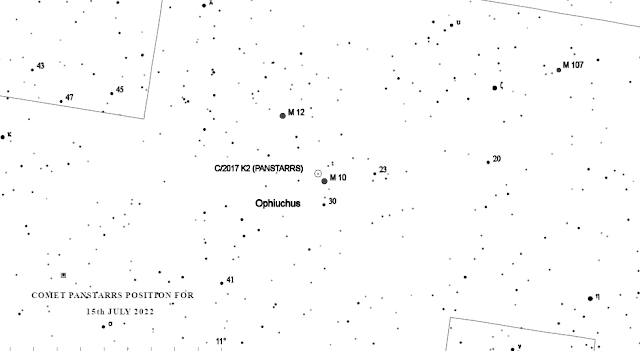
Comet PANSTARRS, C/2017 K2, will be closest to earth on 14th July 2022. The comet at its closest to earth will have a distance of 1.8AU or 269,276,167km in the constellation of Ophiuchus, this distance puts the comet beyond the planet Mars orbit.. The comet is bright enough to be seen in binoculars and small telescopes, the comet has a magnitude of 8. The comet PANSTARRS is well placed for observation, at the time of Sunset the comet will have an altitude of 45 degrees from the horizon, this gives plenty of time to observe, the comet will set at 3:45am.


Comet PANSTARRS, C/2017 K2, is easy to spot in the sky thanks to its closeness to the M10 globular cluster. The comet will be well within the field of view of binoculars, 20X80, until 18th July. Globular cluster M10 is a bright object at 6.6 magnitude, once M10 is the field it won’t be difficult to spot the fuzzy comet . The size of the comet will be roughly the size of M10. 


On 15th July the Comet PANSTARRS, C/2017 K2, will be closest to M10 with a separation of 25 arc minutes. At this small separation the comet and the globular cluster will be in the same field in the telescope, making it a wonderful sight and also to compare the brightness and size of the comet. Hope you all get a chance to view and photograph the comet. 


14 June 2022

Best Times to See Milky Way Galaxy from India


The Milky Way is one of the brightest and famous arms of our galaxy. This is in the region of Scorpius and Sagittarius constellations, this region is also the center of our galaxy. It is a magnificent view when seen under dark skies away from the city light pollution. The Milky Way will appear as a hazy band in the sky, rich with stars, with the brightest region at Sagittarius and dimmer toward north. Many people mistake it for clouds, if you get the doubt, wait for some time and the Milky Way will move along with the stars.


The band of the Milky Way extends from constellations Sagittarius, Sagitta, Cygnus, Cassiopeia to Perseus in the north. To enjoy the full Milky Way band, a place with an unobstructed view of the horizons is essential.        


The Milky Way will be in opposition in the middle of June, that means as the Sun is setting in the west, the Milky Way will be rising in the east. June and July are the best months to enjoy the Milky Way all through the night. I thought making this list of rise, meridian transit and set times of the Milky Way would be useful, so I made one.


Here are the Times for viewing the Milky Way.  


June 15: The Milky Way will rise at 7pm, it will reach meridian, highest altitude in the sky, at midnight and the Milky Way  will set at 5:30am. The Milky Way will be visible all night. 


July 15: The Milky Way will rise at 5pm, reach meridian, highest altitude in the sky at 10:30pm and the Milky Way will set at 3:45pm.


August 15: Milky way will be at meridian, highest altitude in the sky at 8:30pm and the Milky Way will set at 2am.


September 15: By the time the Sun sets, the Milky Way will be at meridian, highest altitude in the sky and it will set at midnight.


October 15: Milky Way will set at 9:30pm.


November 15: Milky Way will set at 7:30pm.


The Sun will be in Sagittarius in December so the Milky Way is not visible. 


Jan 15: The Milky Way will rise at 5am, in twilight.


Feb 15: The Milky Way will rise at 3am.


March 15: The Milky Way will rise at 1am.


April 15: The Milky Way will rise at 11pm and will reach meridian, highest altitude at 4:30am.


May15: The Milky Way will rise at 9pm and it will reach meridian, highest altitude at 2:30am.


As the best months to view the Milky Way galaxy are in the months of June and July, this will make it difficult for south India due to the arrival of Monsoon. To see the band full night or to photograph the band, it is better to move to places where the monsoon has not yet reached. 


You can use the list when going on a trek in a remote place. Check the times during the month and enjoy the view of the Milky Way. 


11 March 2022

Sunday Activity at ABAA: Talk on James Webb Space Telescope


After closing three times due to lockdowns and weekend curfews, ABAA is now back to meeting and conducting activities on Sunday evenings at Planetarium. Last Sunday at ABAA there was a talk on the James Webb Space Telescope given by Ravindra Aradhya, President of ABAA.  This was the part one of the series and concentrated on the optics of James Webb Telescope. The idea behind the talk was on how Amateur Astronomers can relate their making of telescopes with JWST. 


As all telescope makers know, the first and most important part is selecting and buying glass blanks. The selection of glass blanks is done based on the need, thermal expansion is one most important of all the criteria. From Speculum metal, used by Newton and William Herschel, Plate glass, a familiar glass to all amateurs, Pyrex used by many amateurs and observatories to Zerodur used by observatories. The talk covered in detail on the advantages and disadvantages of each type of mirror. 


Beryllium used in the making of the James Webb Space telescope was chosen again with the same criteria. The ability of Beryllium to keep the optical shape intact in different temperatures, this is something all Amateur Telescope Makers (ATM) can relate to and has first had experience in that. 


The next concern is the weight, Beryllium was chosen keeping this also as priority. At ABAA members are very familiar with J. Texerea’s mirror diameter to thickness ratio of 1:6.  This is followed for smaller mirrors but the ratio of 1:10 is considered from larger mirrors. This is done to reduce the weight of the primary mirror. For observatory class mirrors, weight is reduced with hollow mirrors with honeycomb support. We can see this kind of mirror used in Hale telescope at Palomar Observatory. 


After covering the topic of choice of glass and weight reducing methods in mirror making the talk covered in detail on the shape of the James Webb Space Telescope, the Hexagon, The geometry and advantages of multi mirrors with Hexagon mirrors was discussed in detail. When it comes to aligning the mirrors, amateurs can understand the importance and difficulties in collimating a telescope. Many were fascinated to know that the hexagon mirrors are already being used in keck telescopes


Next was on the topic of type of telescopes and amateur astronomers know the two kinds of optics most used, the Newtonians and the Cassegrains. The optics and light path was discussed in detail and members could relate the light path in James Webb telescope. Little more time was spent on understanding theThree-mirror anastigmat optics of James Webb. 


It became easier for members to relate their telescope making experience of grinding, polishing and testing. The method of polishing, difficulties and the precision is something that amateur telescope makers are too familiar with. Members now could appreciate and admire the engineering that went into making of JWST.


The surface error that was allowed and achieved for JWST mirrors was 20 nanometers. This number does not make much sense, it's just a number. Until we convert the 1.3 meter segment into nanometers, this will be 1,300,000,000 nanometers, now there were a lot of raised eyebrows in the room. The deformity on the surface should not exceed 20 nanometers at temperature of 40 kelvin (-233 C). To visualize this, our DNA is just 2 nanometers in diameter. Members and audience were excited to realize how small an error astronomers and amateurs work on.


Finally the topic of coating was discussed. Amateur telescope makers, after polishing and testing their mirrors, send the mirror for aluminum coating. Different kinds of coating 

and their applications were discussed. The sliver, aluminum and gold coating is used for different wavelengths. Since JWST is going to study mainly in InfraRed, gold is the best choice. The talk later covered briefly the process of coating mirrors.


   . 


20 March 2021

How to find Largest Asteroid passing closest to earth?


How to find Largest Asteroid passing closest to earth? Is a good question. The asteroid 2001 FO32 will pass very close to earth and it will be visible in moderate sized backyard telescopes, 8inch aperture and above with dark skies. The asteroid in the eyepiece or in the photograph will appear as a tiny star indistinguishable from the surrounding stars. This makes it a challenging object to spot and confirm. Keeping this in mind I have prepared a star chart and also provided the co ordinate systems of the object so that you can enter this in your GOTO telescope and spot the asteroid.

The apparent motion of the asteroid is fast enough for the motion to be detected with respect to background stars. Only way to confirm that you were successful in spotting the asteroid it so make observations at regular intervals and check for the movement. Taking photos of the region at regular intervals and blinking the photos will help to confirm the asteroid.

Here are the details of the asteroid 2001 FO32 path from 20th of March to 21st of March, this includes chart with hourly movement of the asteroid. The Time and Chart is for Indian Subcontinent. 


Asteroid 2001 FO32 will rise in the constellation of Lupus at 10:50pm IST on 20th March, Moon will be in the sky at the time of asteroid rising but moon will set at midnight giving lot of time to track the Asteroid 2001 FO32.


Above are the co-ordinates for GOTO telescopes to spot Asteroid 2001 FO32. The Asteroid will rise at 4am on 22nd morning making it difficult to spot in low horizon.


Happy hunting.


16 March 2021

Sunday Talk at ABAA: The Ways of Magnetic Fields


The Ways of Magnetic Fields

Talk Given By Raviraj Shinde, Member ABAA and  doing his post graduation in geo magnetism and magnetohydrodynamics at Indian Institute of Science (IISc). 

The magnetic field of the earth has a dipolar structure, with its north magnetic pole close to the south geographic pole, and south magnetic pole close to the north geographic pole. Due to its dipolar structure, it was considered earlier that there may be a giant bar magnet inside the earth. But since the earth's magnetic field has been there for billions of years and the temperature inside the earth is very high that permanent magnetism cannot sustain there. Then in the early 20th-century dynamo theory came into the picture. The Dynamo theory explains how fluid flows of conducting fluid can sustain and intensify given the initial magnetic field inside a planet or a star like a sun.


Earlier it was thought that Earth's magnetic field only helps to navigate, but it has to do a lot more than that. Earth's magnetosphere has been protecting Earth's atmosphere and indirectly all the life on earth from harmful radiation in the form of solar winds. Also, the interaction of the magnetosphere with this solar wind produces beautiful aurora near the Earth's poles. The very interesting phenomenon; the reversal of Earth's magnetic field has not been understood yet. Apart from The Earth Jupiter, Saturn, Uranus, and Neptune are known to have their own magnetic field. Some other planets and natural satellites were having their own magnetic field which is not there today.


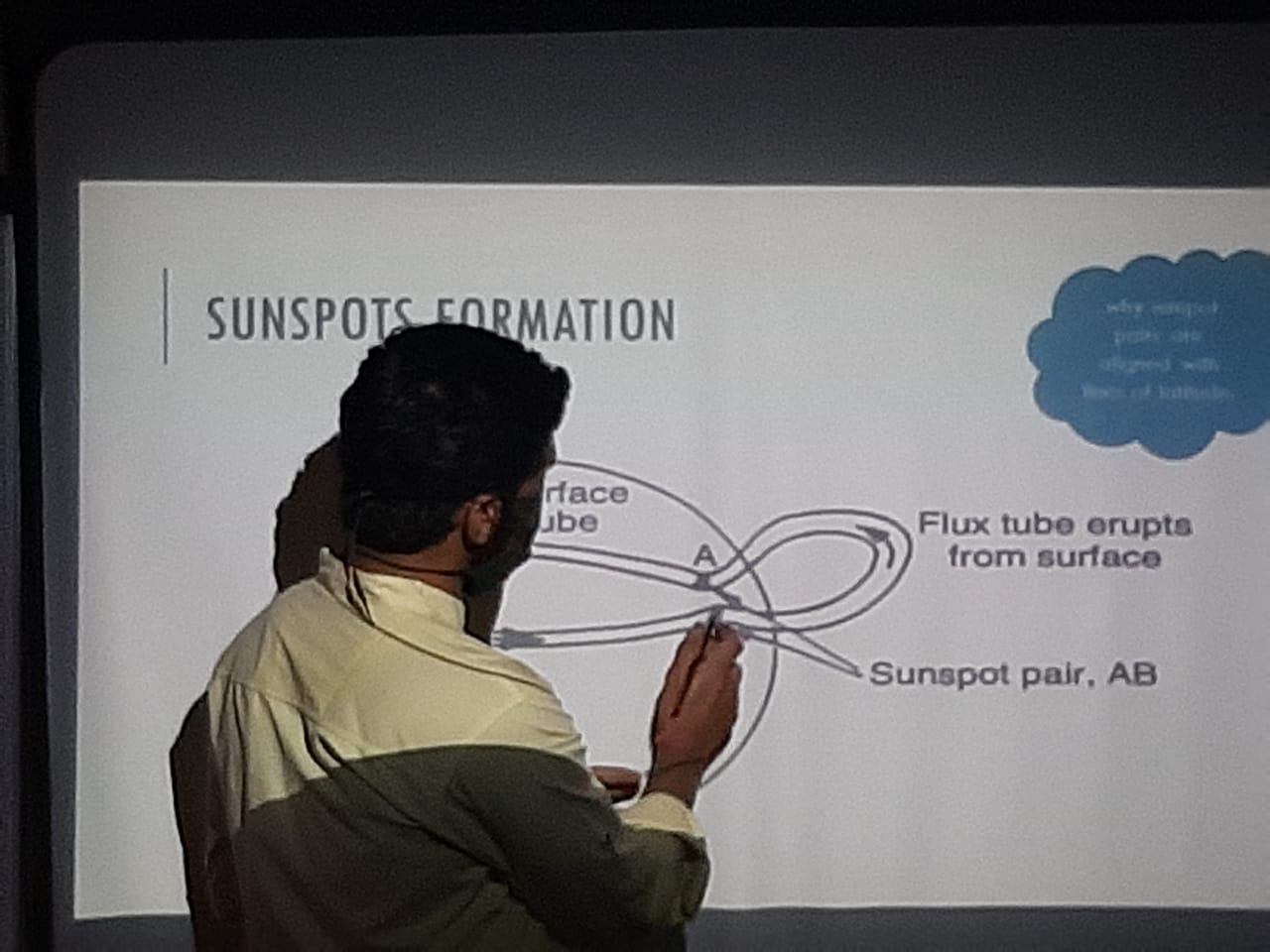
Finally, our own star The Sun has its magnetic field which is very dynamic and capricious. The sunspots were the earliest manifestations of the magnetic field of the sun. This magnetic field is also maintained by the dynamo action in the convection layer, but unlike the Earth's case conducting fluids here is plasma not liquid metal. J.C.Maxwell was the first to observe the relation between 11 solar cycles and maximum disturbance of terrestrial magnetic fields. Sunspots are formed near the equator where azimuthal fields are very intense and these high-intensity magnetic fields suppress turbulent convective motions towards the photosphere. Making the region cooler and hence darker. Since the formation of sunspots is symmetric about the sun's equator and the direction of magnetic flux changes over 11 years so this 11-year solar cycle is related to the reversal of the azimuthal magnetic field. Magnetic flux loops that produce sunspots rise above the photosphere up to the corona layer of its atmosphere. The magnetic field lines in this layer are under tremendous stretching such that they frequently snap and rejoin, in between they release a large amount of heat energy which raises the temperature of the plasma in the corona level to 10^6K. This causes a reduction of density so that solar wind is generated which travels through the solar system spiraling around the sun with a velocity of a few hundred kilometres per second.


Field of magnetohydrodynamics which studies all these and many more phenomenon related to astrophysics. But it has its own limitations, journey started nearly about a century ago has not yet come to an end. And still today researchers are working on dynamo theory to get ourselves closer to the reality.


The discussion went on covering magnetic fields of planets and its importance for atmosphere and ways of studying the magnetic fields of rocky and gaseous planets.  

04 March 2021

Brightest asteroid Vesta in Opposition


The brightest asteroid Vesta is in opposition today, March 4th 2021. It is easily visible through small binoculars even in the light polluted city conditions. Vesta will rise in the east as sun sets in the west. sun, earth and Vesta will be in the same line with earth at the center, this is called opposition. 


Vesta Opposition


Vesta is now placed in the constellation of Leo very close to the bright 3rd magnitude star Theta Leonis. You can spot the asteroid Vesta just 1 degree 15 minutes north east of Theta Leonis. Around 8pm the asteroid will be well placed for spotting but if you have buildings or trees blocking the horizon then you may have to wait until 10pm to spot the asteroid.


Vesta in Leo

Looking through the binoculars or telescope the asteroid will appear as a star, with no hint of shape. This is because of the distance between the earth and Vesta which is now at 1.36 AU(203,453,379km) and the size to the asteroid is 262km in radius.


Vesta Position in Leo

Vesta will be closest to the earth on March 9 2021.


Following Vesta:


With a pair of binoculars or telescope you can notice the movement of Vesta. Choose a couple of stars in the field of view and make a sketch of the field or you can take a photo of the field. With regular observations over the days can show the movement of Vesta with non-moving stars in the field.


Vesta is moving fast at 1 minute of arc in March. If you continue to track Vesta every night or every couple of days you will notice that the distance moved by Vesta is slowing down and in middle of April 2021 Vesta will appear stationary for couple of days and slowly increase the speed as days follow.


Vesta tacking 


You will also notice that from March to April the asteroid Vesta will be moving towards western direction in the Sky, but from first week of May the asteroid will appear moving towards eastern direction in the sky. This is due to the fact that Vesta will be in retrograde motion until April and appear to move towards west and later it will start moving in east. 

Along with angular velocity and direction you will also notice that the asteroid Vesta magnitude also starts dropping. Now in March 2021 Vesta magnitude is 5.9 and post retrograde, that is after April the magnitude of Vesta will drop to 7.2 and it will keep dropping. You can notice this drop in brightness comparing with the stars you have chosen for reference.


Finding and tracking Vesta not only improves the skill of finding objects in the sky using star hopping, it will also make the hobby interesting helping in understanding the concepts like field of view, angular motion, retrograde motion and Magnitude system.


Good Luck Observing!

17 February 2021

The Perseverance Rover Landing on Mars in Indian Standard Time (IST)


Perseverance Rover Credit:NASA
Mars Perseverance Rover is all set to start the landing sequence and explore Mars from February 18th. The 1025kg rover which will weigh only 384kg on mars is equipped with scientific instruments to take readings and samples of the Martian surface to answer the question, "Did life exists on Mars at some point in the past". The descent to Martian surface will start on February 18th and here are the sequence of events that are planned.

The Perseverance Rover Landing on Mars in Indian Standard Time (IST)

Perseverance Rover Landing Indian Standard Time
For USA it will be 18th but for India it will 19th Morning
 Credit: NASA/JPL-Caltech

The red planet's atmosphere is very thin compared to earth, about 1% in volume, mainly made up of carbon dioxide. Even at this thin atmosphere, the heat shield protecting the rover will experience a temperature of 1300 centigrade during descent. The atmosphere breaking will slow the spacecraft descent to 1000km/h and when  at this speed the parachute is deployed, it will slow down the spacecraft further.

  Atmosphere breaking. Credit: NASA/JPL-Caltech

When the spacecraft is slowed down to 320km/h the parachute is detached, the instruments on the spacecraft guides, using radar and camera to safely land the rover on the Martian surface.


You can watch the events Live from NASA's YouTube channel.