Showing posts with label Comet. Show all posts

17 January 2025

COMET C/2024 G3(ATLAS) FROM BANGALORE


The most anticipated comet of the year successfully survived its close approach to the Sun on January 13th and even became a daylight comet. It was visible with small optical aids during the daytime, and many amateur astronomers managed to observe and photograph it under daylight conditions. Now, the comet is visible in the western evening skies during twilight hours.


The comet is still bright enough to be seen with the naked eye. To spot it, find a location with a clear horizon, free of obstructions like buildings or trees. This might be a bit challenging in cities like Bangalore. Just after sunset, start scanning the twilight sky for the comet. At first glance, it may appear as a dim, elongated, fuzzy object. As the sky gets darker, the comet will become more prominent. Binoculars can be helpful in spotting it, but remember to wait until the Sun has completely set below the horizon. The chart provided below will aid in locating and tracking the comet in the coming days.

The comet is currently approximately the same distance from us as the Sun—150,000,000 km—and this distance will continue to increase, causing the comet to appear dimmer. For those in Bangalore and nearby areas, the comet is well-placed in the sky; you only need a clear horizon. However, as the comet fades in the coming days and its brightness drops below magnitude 2, light pollution will become a significant factor. Try to observe it from a location with minimal light pollution.


Towards the end of the month, binoculars will be essential for spotting the comet. While it will appear slightly higher in the sky at sunset, it will also be dimmer. A dark sky and optical aids like binoculars or telescopes will greatly enhance your viewing experience at this time.

Bright comets are rare, but when they do appear, they offer a wealth of beauty and valuable insights into the formation of the solar system. Don't miss the opportunity to spot this rare visitor in the evening sky and enjoy the magnificent view.


13 July 2022

Comet PANSTARRS closest to Earth on July 14th


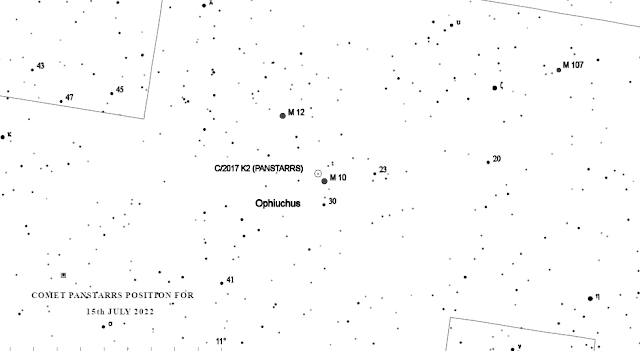
Comet PANSTARRS, C/2017 K2, will be closest to earth on 14th July 2022. The comet at its closest to earth will have a distance of 1.8AU or 269,276,167km in the constellation of Ophiuchus, this distance puts the comet beyond the planet Mars orbit.. The comet is bright enough to be seen in binoculars and small telescopes, the comet has a magnitude of 8. The comet PANSTARRS is well placed for observation, at the time of Sunset the comet will have an altitude of 45 degrees from the horizon, this gives plenty of time to observe, the comet will set at 3:45am.


Comet PANSTARRS, C/2017 K2, is easy to spot in the sky thanks to its closeness to the M10 globular cluster. The comet will be well within the field of view of binoculars, 20X80, until 18th July. Globular cluster M10 is a bright object at 6.6 magnitude, once M10 is the field it won’t be difficult to spot the fuzzy comet . The size of the comet will be roughly the size of M10. 


On 15th July the Comet PANSTARRS, C/2017 K2, will be closest to M10 with a separation of 25 arc minutes. At this small separation the comet and the globular cluster will be in the same field in the telescope, making it a wonderful sight and also to compare the brightness and size of the comet. Hope you all get a chance to view and photograph the comet. 


15 February 2021

Sun as Blind(Bright) Spot


Blind Spot, something we are all familiar with and have experienced it one time or the other. With all the mirrors around in the car or truck there will be one area where we cannot see and we have to adapt and work around it. Sometimes its a matter of life and death. Something which we cannot observe even with mirrors, this got me thinking of astronomers and their mirrors, the telescope and blind spot ,that area where observation is not possible. Earth rotates on its axis every 24 hours and if a solar eclipse is happening in USA, we in India will be at the opposite side with nightfall, but at-least someone got to see the eclipse. But there are places in the sky where if some events happen nowhere on earth can we see or observe the event. This is the portion of the sky where the Sun is placed.


On a new moon day we cannot the see the moon, it's not that moon has vanished from the sky but its hidden in the glare of the Sun. When a celestial object is close to the Sun we call that object as, in conjunction with Sun. During new moon phase the moon is in conjunction with the Sun. This applies to planets too, planets Jupiter and Saturn were in conjunction with Sun in late January of this year and as you know by now, conjunction means close to the Sun. When planets are in conjunction with the Sun observations cannot happen and we have to wait for the planets to come out of Sun's glare. This can take from several days to months and during that time there is nothing that the earth bound astronomers can do but wait.


The dreaded wait, how many of you reading this article remember the wait for the emergence of COMET ISON in 2013. The COMET ISON was dubbed to be the comet of the century and was to be the brightest comet in the sky after its perihelion (close approach to Sun). The comet was observed and followed until it fell into the glare of the Sun, amateurs and professional astronomers waiting to see the reappearance never got the chance as the comet got disintegrated during its close approach to Sun. We had wonderful images before it went close to Sun, but as it got close to Sun all we could do was to wait for emergence as sun's glare hid the comet.


If we go back in time to 1994 and the event of great impact of comet Shoemaker Levy 9 on to the planet Jupiter, which proved Eugene Shoemaker's theory of the impacts by comets and asteroids on Planets are common, well in astronomical timeline of-course. The event took place in July and telescopes around the world were pointing at Jupiter and astronomers studied the event in great detail. At that time Jupiter was in the constellation of Virgo and the Sun was in the constellation of Gemini. Imagine if the same event would have taken place during conjunction of Jupiter with Sun, we would have missed the great event.


Its not only planets but stars and other celestial objects too that come close to the Sun in the sky during the year, reaching conjunction, and those objects also cannot be observed until they emerge out of the glare. For example ,in the month of February Sun is in the constellation of Capricornus and we cannot see the stars or the objects in the constellation due to the bright Sun.


In the month of January of 2020 the red star in Orion constellation, Betelgeuse, dimmed in brightness unexpectedly and astronomers were able to measure the brightness until it came back to its original brightness in April of 2020. This was a good opportunity to study the brightness variation of the star as Betelgeuse was well placed in the sky away from the bright Sun. The same event if it had happened in the month of June, you know where I am going with this, yes Betelgeuse will be in conjunction with Sun in June.


There are many such rare events that we could have missed if the event had taken place during conjunction with Sun, even the closest supernova in Large Magellanic Cloud which took place in 1987 if it had happened during conjunction.


Sun is a big blind spot for astronomers, even with their mirrors they will miss anything close to Sun. Astronomers take advantage of even the smallest window and try to learn everything they can, because they know that these are rare events. For astronomers there is no such thing as being at right time at right place, they have to make best of what they get.


Knowing this I am very sure that it will make us look at each event and night as a gift and accept it with a sense of gratitude.


15 September 2019

C/2019 Q4 (Borisov) Visitor from Beyond


Amateurs discovery continues. Many amateurs patrol the skies in a systematic way and keep discovering comets, Asteroids, Variable stars, Nova and Supernova and even galaxies. This August 30th, amateur astronomer Gennady Borisov scanning the skies from Nauchnij near black sea in Ukraine reported discovery of a comet using his 25 inch telescope. After the initial observations were made it became clear that this comet could be a visitor from beyond solar system. This comet is designated as C/2019 Q4 (Borisov) may be changed to I/2019 Q4 (Borisov) as I/ (I indicating Interstellar) was adapted in 2017.

C/2019 Q4 (Borisov) in Cassiopeia constellation is slowly progressing towards perihelion on 9 December 2019 at 1.96 au (Piotr Guzik, et al) and is in hyperbolic orbit. Astronomers have photographed the comet C/2019 Q4 (Borisov) using 8.1 meter (319 inch) telescope.


Gemini Observatory two-color composite image of C/2019 Q4 (Borisov) which is the first interstellar comet ever identified. This image was obtained using the Gemini North Multi-Object Spectrograph (GMOS) from Hawaii’s Maunakea. The image was obtained with four 60-second exposures in bands (filters) r and g. Blue and red dashes are images of background stars which appear to streak due to the motion of the comet. Composite image by Travis Rector.
Image Credit: Gemini Observatory/NSF/AURA


The C/2019 Q4 (Borisov) will not come within the orbit of Mars even in at Perihelion (closest to Sun) . Here is the orbit of C/2019 Q4 (Borisov) at the closest to Sun and also we can visualize the path of the comet with high eccentricity. Many planetarium programs may have to add a new feature to accept this high eccentricity. This image is of the top view of the solar system or as seen from north ecliptic pole. To give a good location on where we have to be to have this top view of our solar system is close to Cat's eye nebula in Draco. This image clearly shows the path of comet C/2019 Q4 (Borisov) will be beyond Mars.


The next image shows  the orientation of the path of C/2019 Q4 (Borisov) with respect to our orbital plane.


The comet is currently  at a visual magnitude of 17.7 and at its closest approach to Sun ,the magnitude will be 15.5, these values may change if there are any changes in the comet. The C/2019 Q4 (Borisov) will be closest to earth on 28th December 2019.


04 March 2013

Comet PANSTARRS(C/2011 L4) is Here


Comet PANSTARRS (C/2011 L4) has given a good show in southern hemisphere and it’s now time for northern hemisphere to enjoy the show. On 5th March Comet will pass close to Earth at approx 1.1AU(1 AU = 149 597 871 km) and will reach perihelion(close to Sun in distance) on March 10th at a distance of .3AU(1 AU = 149 597 871 km).  PANSTARRS(C/2011 L4) should be a good challenging object from 6th of March from Bangalore and becomes easier to spot as days pass. The comet will stay low in the western horizon after sunset, the altitude of the comet PANSTARRS (C/2011 L4) will be 5degrees at 6:45pm on 5th march and on 12th of March the altitude will be 10degrees from the western horizon at 6:45pm. Due to the low altitude of the comet, it is better to plan the observation session in a place where there is no obstruction in the western horizon like trees or buildings. Here are few charts with the positions of the comet PANSTARRS (C/2011 L4) after sunset. The charts are from 5th to 12th of March with altitude of the comet at 6:45pm.


Chart of  5th March Comet PANSTARRS(C/2011 L4)  altitude will be close to 5degress at 6:45pm.  Sunset: 6:32pm. Comet PANSTARRS(C/2011 L4) sets at 7:10pm 
 

Chart of  6th March Comet PANSTARRS (C/2011 L4) altitude will be close to 6.5degress at 6:45pm.  Sunset: 6:32pm. Comet PANSTARRS(C/2011 L4) sets at 7:15pm.
 

Chart of  7th March Comet PANSTARRS(C/2011 L4)  altitude will be close to 8degress at 6:45pm.  Sunset: 6:32pm. Comet PANSTARRS(C/2011 L4) sets at 7:20pm
 

Chart of  8th March Comet PANSTARRS(C/2011 L4)  altitude will be close to 8.5degress at 6:45pm.  Sunset: 6:32pm. Comet PANSTARRS(C/2011 L4) sets at 7:23pm
 

Chart of  9th March Comet PANSTARRS(C/2011 L4)  altitude will be close to 9.5degress at 6:45pm.  Sunset: 6:32pm. Comet PANSTARRS(C/2011 L4) sets at 7:25pm

Chart of  10th March Comet PANSTARRS(C/2011 L4)  altitude will close to be 10degress at 6:45pm.  Sunset: 6:32pm. Comet PANSTARRS(C/2011 L4) sets at 7:28pm.
 

Chart of  11th March Comet PANSTARRS(C/2011 L4)  altitude will be close to 10.5degress at 6:45pm.  Sunset: 6:32pm. Comet PANSTARRS(C/2011 L4) sets at 7:30pm
 

Chart of  12th March Comet PANSTARRS(C/2011 L4)  altitude will be close to 10.6degress at 6:45pm.  Sunset: 6:32pm.Comet PANSTARRS(C/2011 L4) sets at 7:30pm


06 November 2010

Sky charts for C/2010 V1 (Ikeya-Murakami) comet

Here are few approximate reference sky charts for the spotting comet C/2010 V1 (Ikeya-Murakami). As the comet is bright, just scan the area shown in the sky charts, and comet should be in the field. Hope for clear skies. The comet can be spotted with binoculars or telescope in the early morning, in the constellation of Virgo. Charts are below rise times of comet C/2010 V1 (Ikeya-Murakami)

Date: Rise(IST)

08 Nov 2010: 03:58:35

09 Nov 2010: 03:57:30

10 Nov 2010: 03:56:24

11 Nov 2010: 03:55:18

12 Nov 2010: 03:54:12

13 Nov 2010: 03:53:05

14 Nov 2010: 03:51:57

15 Nov 2010: 03:50:50

16 Nov 2010: 03:49:42

17 Nov 2010: 03:48:33

18 Nov 2010: 03:47:24

19 Nov 2010: 03:46:15

20 Nov 2010: 03:45:05

21 Nov 2010: 03:43:55

22 Nov 2010: 03:42:44

23 Nov 2010: 03:41:33

24 Nov 2010: 03:40:22

25 Nov 2010: 03:39:10

26 Nov 2010: 03:37:57

27 Nov 2010: 03:36:44

28 Nov 2010: 03:35:31

29 Nov 2010: 03:34:17

30 Nov 2010: 03:33:02


C/2010 V1 (Ikeya-Murakami) on Nov 8


C/2010 V1 (Ikeya-Murakami) on Nov 11th


C/2010 V1 (Ikeya-Murakami) on Nov 16th


C/2010 V1 (Ikeya-Murakami) on Nov 19th


C/2010 V1 (Ikeya-Murakami) Nov 23rd


C/2010 V1 (Ikeya-Murakami) Nov 27th