16 March 2021

Sunday Talk at ABAA: The Ways of Magnetic Fields


The Ways of Magnetic Fields

Talk Given By Raviraj Shinde, Member ABAA and  doing his post graduation in geo magnetism and magnetohydrodynamics at Indian Institute of Science (IISc). 

The magnetic field of the earth has a dipolar structure, with its north magnetic pole close to the south geographic pole, and south magnetic pole close to the north geographic pole. Due to its dipolar structure, it was considered earlier that there may be a giant bar magnet inside the earth. But since the earth's magnetic field has been there for billions of years and the temperature inside the earth is very high that permanent magnetism cannot sustain there. Then in the early 20th-century dynamo theory came into the picture. The Dynamo theory explains how fluid flows of conducting fluid can sustain and intensify given the initial magnetic field inside a planet or a star like a sun.


Earlier it was thought that Earth's magnetic field only helps to navigate, but it has to do a lot more than that. Earth's magnetosphere has been protecting Earth's atmosphere and indirectly all the life on earth from harmful radiation in the form of solar winds. Also, the interaction of the magnetosphere with this solar wind produces beautiful aurora near the Earth's poles. The very interesting phenomenon; the reversal of Earth's magnetic field has not been understood yet. Apart from The Earth Jupiter, Saturn, Uranus, and Neptune are known to have their own magnetic field. Some other planets and natural satellites were having their own magnetic field which is not there today.
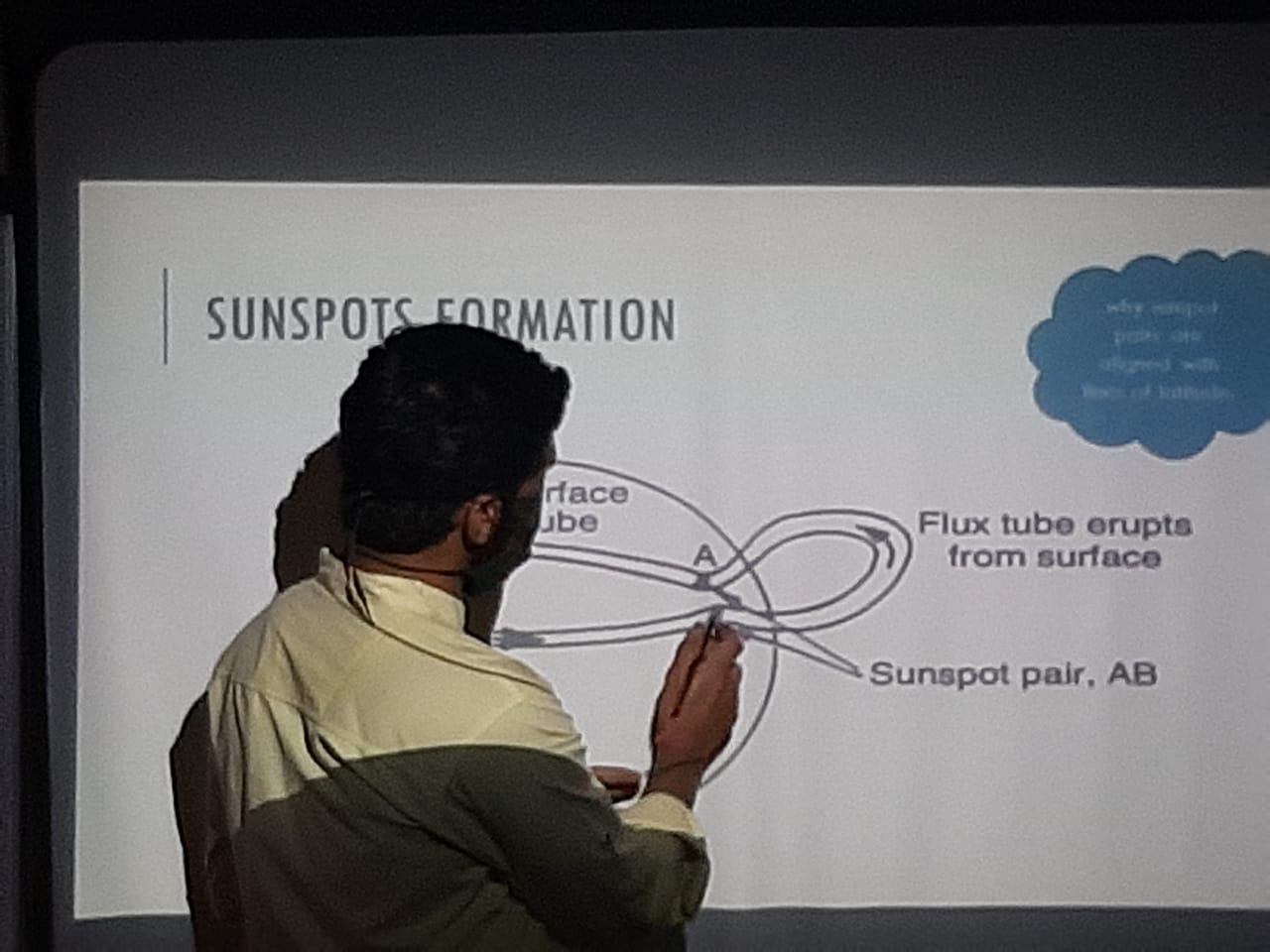


Finally, our own star The Sun has its magnetic field which is very dynamic and capricious. The sunspots were the earliest manifestations of the magnetic field of the sun. This magnetic field is also maintained by the dynamo action in the convection layer, but unlike the Earth's case conducting fluids here is plasma not liquid metal. J.C.Maxwell was the first to observe the relation between 11 solar cycles and maximum disturbance of terrestrial magnetic fields. Sunspots are formed near the equator where azimuthal fields are very intense and these high-intensity magnetic fields suppress turbulent convective motions towards the photosphere. Making the region cooler and hence darker. Since the formation of sunspots is symmetric about the sun's equator and the direction of magnetic flux changes over 11 years so this 11-year solar cycle is related to the reversal of the azimuthal magnetic field. Magnetic flux loops that produce sunspots rise above the photosphere up to the corona layer of its atmosphere. The magnetic field lines in this layer are under tremendous stretching such that they frequently snap and rejoin, in between they release a large amount of heat energy which raises the temperature of the plasma in the corona level to 10^6K. This causes a reduction of density so that solar wind is generated which travels through the solar system spiraling around the sun with a velocity of a few hundred kilometres per second.


Field of magnetohydrodynamics which studies all these and many more phenomenon related to astrophysics. But it has its own limitations, journey started nearly about a century ago has not yet come to an end. And still today researchers are working on dynamo theory to get ourselves closer to the reality.


The discussion went on covering magnetic fields of planets and its importance for atmosphere and ways of studying the magnetic fields of rocky and gaseous planets.  

04 March 2021

Brightest asteroid Vesta in Opposition


The brightest asteroid Vesta is in opposition today, March 4th 2021. It is easily visible through small binoculars even in the light polluted city conditions. Vesta will rise in the east as sun sets in the west. sun, earth and Vesta will be in the same line with earth at the center, this is called opposition. 


Vesta Opposition


Vesta is now placed in the constellation of Leo very close to the bright 3rd magnitude star Theta Leonis. You can spot the asteroid Vesta just 1 degree 15 minutes north east of Theta Leonis. Around 8pm the asteroid will be well placed for spotting but if you have buildings or trees blocking the horizon then you may have to wait until 10pm to spot the asteroid.


Vesta in Leo

Looking through the binoculars or telescope the asteroid will appear as a star, with no hint of shape. This is because of the distance between the earth and Vesta which is now at 1.36 AU(203,453,379km) and the size to the asteroid is 262km in radius.


Vesta Position in Leo

Vesta will be closest to the earth on March 9 2021.


Following Vesta:


With a pair of binoculars or telescope you can notice the movement of Vesta. Choose a couple of stars in the field of view and make a sketch of the field or you can take a photo of the field. With regular observations over the days can show the movement of Vesta with non-moving stars in the field.


Vesta is moving fast at 1 minute of arc in March. If you continue to track Vesta every night or every couple of days you will notice that the distance moved by Vesta is slowing down and in middle of April 2021 Vesta will appear stationary for couple of days and slowly increase the speed as days follow.


Vesta tacking 


You will also notice that from March to April the asteroid Vesta will be moving towards western direction in the Sky, but from first week of May the asteroid will appear moving towards eastern direction in the sky. This is due to the fact that Vesta will be in retrograde motion until April and appear to move towards west and later it will start moving in east. 

Along with angular velocity and direction you will also notice that the asteroid Vesta magnitude also starts dropping. Now in March 2021 Vesta magnitude is 5.9 and post retrograde, that is after April the magnitude of Vesta will drop to 7.2 and it will keep dropping. You can notice this drop in brightness comparing with the stars you have chosen for reference.


Finding and tracking Vesta not only improves the skill of finding objects in the sky using star hopping, it will also make the hobby interesting helping in understanding the concepts like field of view, angular motion, retrograde motion and Magnitude system.


Good Luck Observing!

17 February 2021

The Perseverance Rover Landing on Mars in Indian Standard Time (IST)


Perseverance Rover Credit:NASA
Mars Perseverance Rover is all set to start the landing sequence and explore Mars from February 18th. The 1025kg rover which will weigh only 384kg on mars is equipped with scientific instruments to take readings and samples of the Martian surface to answer the question, "Did life exists on Mars at some point in the past". The descent to Martian surface will start on February 18th and here are the sequence of events that are planned.

The Perseverance Rover Landing on Mars in Indian Standard Time (IST)

Perseverance Rover Landing Indian Standard Time
For USA it will be 18th but for India it will 19th Morning
 Credit: NASA/JPL-Caltech

The red planet's atmosphere is very thin compared to earth, about 1% in volume, mainly made up of carbon dioxide. Even at this thin atmosphere, the heat shield protecting the rover will experience a temperature of 1300 centigrade during descent. The atmosphere breaking will slow the spacecraft descent to 1000km/h and when  at this speed the parachute is deployed, it will slow down the spacecraft further.

  Atmosphere breaking. Credit: NASA/JPL-Caltech

When the spacecraft is slowed down to 320km/h the parachute is detached, the instruments on the spacecraft guides, using radar and camera to safely land the rover on the Martian surface.


You can watch the events Live from NASA's YouTube channel.


15 February 2021

Sun as Blind(Bright) Spot


Blind Spot, something we are all familiar with and have experienced it one time or the other. With all the mirrors around in the car or truck there will be one area where we cannot see and we have to adapt and work around it. Sometimes its a matter of life and death. Something which we cannot observe even with mirrors, this got me thinking of astronomers and their mirrors, the telescope and blind spot ,that area where observation is not possible. Earth rotates on its axis every 24 hours and if a solar eclipse is happening in USA, we in India will be at the opposite side with nightfall, but at-least someone got to see the eclipse. But there are places in the sky where if some events happen nowhere on earth can we see or observe the event. This is the portion of the sky where the Sun is placed.


On a new moon day we cannot the see the moon, it's not that moon has vanished from the sky but its hidden in the glare of the Sun. When a celestial object is close to the Sun we call that object as, in conjunction with Sun. During new moon phase the moon is in conjunction with the Sun. This applies to planets too, planets Jupiter and Saturn were in conjunction with Sun in late January of this year and as you know by now, conjunction means close to the Sun. When planets are in conjunction with the Sun observations cannot happen and we have to wait for the planets to come out of Sun's glare. This can take from several days to months and during that time there is nothing that the earth bound astronomers can do but wait.


The dreaded wait, how many of you reading this article remember the wait for the emergence of COMET ISON in 2013. The COMET ISON was dubbed to be the comet of the century and was to be the brightest comet in the sky after its perihelion (close approach to Sun). The comet was observed and followed until it fell into the glare of the Sun, amateurs and professional astronomers waiting to see the reappearance never got the chance as the comet got disintegrated during its close approach to Sun. We had wonderful images before it went close to Sun, but as it got close to Sun all we could do was to wait for emergence as sun's glare hid the comet.


If we go back in time to 1994 and the event of great impact of comet Shoemaker Levy 9 on to the planet Jupiter, which proved Eugene Shoemaker's theory of the impacts by comets and asteroids on Planets are common, well in astronomical timeline of-course. The event took place in July and telescopes around the world were pointing at Jupiter and astronomers studied the event in great detail. At that time Jupiter was in the constellation of Virgo and the Sun was in the constellation of Gemini. Imagine if the same event would have taken place during conjunction of Jupiter with Sun, we would have missed the great event.


Its not only planets but stars and other celestial objects too that come close to the Sun in the sky during the year, reaching conjunction, and those objects also cannot be observed until they emerge out of the glare. For example ,in the month of February Sun is in the constellation of Capricornus and we cannot see the stars or the objects in the constellation due to the bright Sun.


In the month of January of 2020 the red star in Orion constellation, Betelgeuse, dimmed in brightness unexpectedly and astronomers were able to measure the brightness until it came back to its original brightness in April of 2020. This was a good opportunity to study the brightness variation of the star as Betelgeuse was well placed in the sky away from the bright Sun. The same event if it had happened in the month of June, you know where I am going with this, yes Betelgeuse will be in conjunction with Sun in June.


There are many such rare events that we could have missed if the event had taken place during conjunction with Sun, even the closest supernova in Large Magellanic Cloud which took place in 1987 if it had happened during conjunction.


Sun is a big blind spot for astronomers, even with their mirrors they will miss anything close to Sun. Astronomers take advantage of even the smallest window and try to learn everything they can, because they know that these are rare events. For astronomers there is no such thing as being at right time at right place, they have to make best of what they get.


Knowing this I am very sure that it will make us look at each event and night as a gift and accept it with a sense of gratitude.


03 July 2020

Sun Farthest from Earth

Sun is far away and still its hot summer in the northern hemisphere. This is the question many have, relating to the distance to the Sun and seasons on earth. The seasons on earth is due to the tilt of the earth at 23.5 degrees. Due to this tilt northern and southern hemispheres are exposed to the Sun during certain months of the year. While Northern hemisphere is exposed to more sun during March to September, the Southern hemisphere will be going through winter and situation reverses after September. From September to March Southern hemisphere is exposed to more Sun and it will be Summer in southern hemisphere while northern hemisphere will be experiencing winter. This is how seasons change on earth.

Earth Tilt and Seasons Credit:CC

Earth makes one full revolution of the Sun in approx 365.256 days. In this orbit around the Sun there are two points where the Sun and earth are closest, called Perihelion, and the other point is the farthest distance between Sun and earth and this point is called Aphelion. The two points Perihelion and Aphelion exists because the orbit of earth around the Sun is not a circular one, it orbits in an elliptical orbit but the difference is very small at an eccentricity of 0.0167. This small elliptical orbit makes the earth”s perihelion distance close to 147 million kilometres and aphelion distance close to 152 million kilometres.

Earth elliptical orbit Perihelion and Aphelion  Credit: ABAA

Earth reaches perihelion on January 5th and aphelion on July 4th. During Perihelion the Sun is in the constellation of Sagittarius and earth will be moving around the Sun at a velocity of 1,08,900km/h and has an angular diameter of 32m32s of arc. During Aphelion on July 4th Sun will be in the constellation of Gemini and earth will be moving around the Sun at a velocity of 1,07,208km/h and will have angular diameter of 31m28s of arc.


Sun Angular size at Aphelion and Perihelion  Credit: ABAA


Happy Observing and Clear Skies.


23 June 2020

Partial Solar Eclipse Volunteering of ABAA members at Planetarium on June 21,2020

The Partial Solar Eclipse on June 21st was a sober affair at Planetarium. This was due to social distancing in the middle of Corona virus situation. Planetarium had arranged live streaming of the eclipse from different types of telescopes. Few ABAA members were invited to volunteer for the event and handle the telescopes. Members following rules of social distancing managed the event very well, taking pictures of the eclipse, guiding the telescopes, helping the press to get good images of eclipse and also giving information on eclipse. Members had mixed feeling about the eclipse, on one side they were happy to see the eclipse without cloud cover at the same time they were feeling sad that they could not share the experience with public. Here are few picture of members at Planetarium during the event.


Projecting the Sun on to a wall or on a white cardboard paper is one of safe methods for observing Sun during eclipse and also while observing Sunspots. Here a projection box is attached to the Planetarium's Telescope, the box has a semi transparent paper in the middle of box where the image of the Sun forms and it can be viewed safely. ABAA member Naveen is headlining the telescope.


One of the live streaming of the Partial Solar eclipse was done from the 6 inch refractor telescope which has a massive focal length of 90 inches. It is coude focus telescope. The image is very stable and does not move as telescope tracks the Sun or any celestial object. This is the main advantage of coude focus.


ABAA helps members to make their own telescope and assemble the telescopes. This is something ABAA is regularly doing from four decades. Members had got their own telescope for the event, here you can see a member using the telescope, the front end of the tube is covered with solar filter making safe to observe the Sun. 


ABAA member is guiding the telescope at Planetarium. This is a favorite type of telescope mount used by amateur astronomers for observing the celestial objects. ABAA is making this kind of mount and using it from couple of decades now. It is easy to make and easy to use, even in deep sky observations.


Binoculars are one more favorite optics of amateur astronomers and in fact ABAA recommends binoculars for starting out in astronomy. Because of its large field of view it makes a good choice. Here the binoculars lens are covered with Solar filters for safe viewing. There are hundred of celestial objects that can be viewed through binocular at night, even small ones like 10X50.  


Another interesting setup at the event was heliostat, a system of mirrors arranged in a particular way which makes the image of the Sun fall on the wall and keeps the image study. The mirrors tracks the Sun but image of the Sun is kept in one place.    


ABAA members do lot of Astrophotography too, and members do discuss lot of techniques involved in Astrophotography at ABAA regularly. Here members are capturing eclipse event through long focal length lens with filters. The filter casing was home made by members, telescope making and astrophotography involves lot of DIY which makes the hobby more exciting...


It was a good session at Planetarium, clouds did not ruin the event and members could enjoy the event for the most part.

Members have taken lot of good pictures of the eclipse, next blog post will feature the efforts of ABAA members in capturing the Partial Solar Eclipse.

Be safe and Clear Skies.

18 June 2020

Partial Solar Eclipse from Bangalore 21 June 2020

After the partial solar eclipse on December 26, 2019 which was visible from Bangalore, now after six months we have one more partial solar eclipse visible from Bangalore. 

On June 21st Sunday we are going to witness the partial solar eclipse in the morning sky. The eclipse will start at 10:12:56 and at this time Sun will be 58 degrees above the eastern horizon. With proper solar filter or using different safe observing methods its a good idea to start observing couple of minutes before the given time. The start of eclipse is when you see moon disc starts coming inside Sun's disc, this is called first contact, when Sun and Moon discs touch each other. As we observe the dark disc of moon will start covering more and more of the Sun's disc and after reaching a certain point the disc of moon starts to move away. This is called Maximum eclipse, the point or time when Moon covers the maximum surface of Sun's disc. This will occur at 11:47:38 and at this time Sun would have moved higher in the sky at close to 77 degrees from eastern horizon. As we continue observing or photographing we will see that the dark disc of moon getting smaller and it will come out of Sun's surface completely at 13:31:44 marking the end of eclipse, the time of moon disc coming of Sun is called last contact. At this time Sun will be in the western part of the sky at close to 70degrees from the western horizon. 

Solar Eclipse Bangalore 21 June 2020


As we all know June 21st is Solstice, on this day Sun's reaches the northern most point from equator at 23.5degrees. From June until December Sun will move in southern direction. Sun on June 21st will be on the border of Taurus and Gemini constellations. The borders of constellations are set by International Astronomical Union (IAU). The shapes and borders differ in different regions and cultures, Astronomers use the shapes and borders set by IAU.

This eclipse is an annular eclipse and parts of north India will witness the ring of fire, that is Sun will appears like a ring with moon obstructing the disc of Sun leaving only edges around the Sun glowing. The reason for this ring is because of different apparent sizes of Sun and moon. These two objects subtends an angle of half of degree in the sky, if one of them is smaller or bigger we get annular eclipse. If moon has an angular diameter smaller then the Sun we have annular eclipse as moon cannot cover the entire disc of Sun. Here are the angular sizes of Sun and Moon on June 21st Sun will have a of Diameter: 31'28.4" and Moon will have a Diameter: 31'16.0". As we can see Moon is smaller and this is the reason for annular eclipse. The difference in sizes happens due to elliptic orbit of earth around the Sun and elliptic orbit of moon around the earth. 

Eclipses are rare and we have to travel long distances to be in the center path, we have to go to north India around Kurukshetra to see the ring of fire, annular eclipse on June 21st. Last year on December 26th we had to go to Kerala and Tamil Nadu to witness the annular eclipse. Since we are unable to travel in these lock down situations, we will have to wait until May 21st 2031 to enjoy the solar eclipse in India. The path of annular in 2031 will be in south India.

If some one decides not to leave Bangalore for eclipse but wants central path of eclipse to come to Bangalore, they will have to wait for the year 2085. Yes, on June 22nd 2085 people in Bangalore can see the ring of fire, the annular eclipse. Mark your calendars, it just 65 years away.

For now we have to be content with partial eclipse on Sunday and hope for clear skies. Happy observing every one, observe safely with proper filters or pin hole camera projection on the wall. NEVER LOOK AT SUN DIRECTLY.